

You finished a hard workout, ate a protein-rich dinner, and went to bed with good intentions. Then work messages, restless legs, or a busy mind kept you awake. This morning, your muscles feel heavy, and you're wondering whether to train, rest, or add another recovery supplement.
Sleep and muscle recovery are connected, but not through a simple good-night/bad-night switch. A sleepless night in a laboratory isn't the same as waking occasionally at home. Feeling sharper during a workout isn't proof that you've built more muscle, either. Understanding those differences helps you make better decisions without panicking over every imperfect night.
Table of Contents
- Sleep Targets for Every Training Load
- How Sleep Stages Drive Overnight Muscle Repair
- What Short Sleep Does to Repair Hormones and Protein Synthesis
- How Much One Bad Night Really Hurts Training
- Whether Naps and Extra Sleep Help Recovery
- Nutrients Linked to Recovery Sleep and What Evidence Shows
- Build an Evening Routine That Protects Recovery
- Start a Two-Week Sleep Audit Before Your Next Block
Sleep Targets for Every Training Load
| Training load | Sleep target per night | Action when the target is missed |
|---|---|---|
| Light activity, under 3 sessions a week | 7 hours or more in bed | Keep a fixed wake time and move bedtime earlier if you fall short |
| Regular training, 3 to 5 sessions a week | About 8 hours in bed | Move bedtime 30 minutes earlier for three nights |
| High volume or two sessions a day | 8 to 9 hours in bed | Add a short extra window before a heavy block and cut late sessions |
| Competition week | 8 hours or more in bed | Keep the normal wake time and avoid late nights |
These are planning ranges, not trial-proven prescriptions for each training load. The CDC's adult sleep guidance recommends at least seven hours of actual sleep for adults aged 18–60, so the light-activity row is only a starting point: seven hours in bed won't necessarily deliver seven hours asleep.
The athlete reference is different. A 2024 conference proceeding published by The Nutrition Society and Cambridge University Press reported that 175 elite athletes self-reported needing 8.3 ± 0.9 hours of sleep. That's useful context for planning, not evidence that everyone who lifts needs an identical amount.
Turn a target into an appointment
For light activity, protect a dependable bedtime before worrying about optimizing every detail. With regular training, an earlier bedtime is usually more controllable than hoping your morning schedule will change.
During a demanding block, arrange extra sleep opportunity before fatigue becomes a problem. That might mean moving an evening session to lunchtime or preparing tomorrow's equipment before dinner. During competition week, avoid making your schedule more erratic in an attempt to force extra rest.
Sleep also belongs within a wider recovery plan. MEDISTIK's practical resource on ways to improve recovery after intense exercise can help you consider sleep alongside other post-training habits rather than treating any single method as a complete solution.
Planning rule: Reserve enough time for falling asleep and overnight waking, not just the number you want to see on your sleep log.
Find your row and count how many nights last week reached the target. Start that count now, then use the audit below to compare planned sleep opportunity with actual sleep.
How Sleep Stages Drive Overnight Muscle Repair
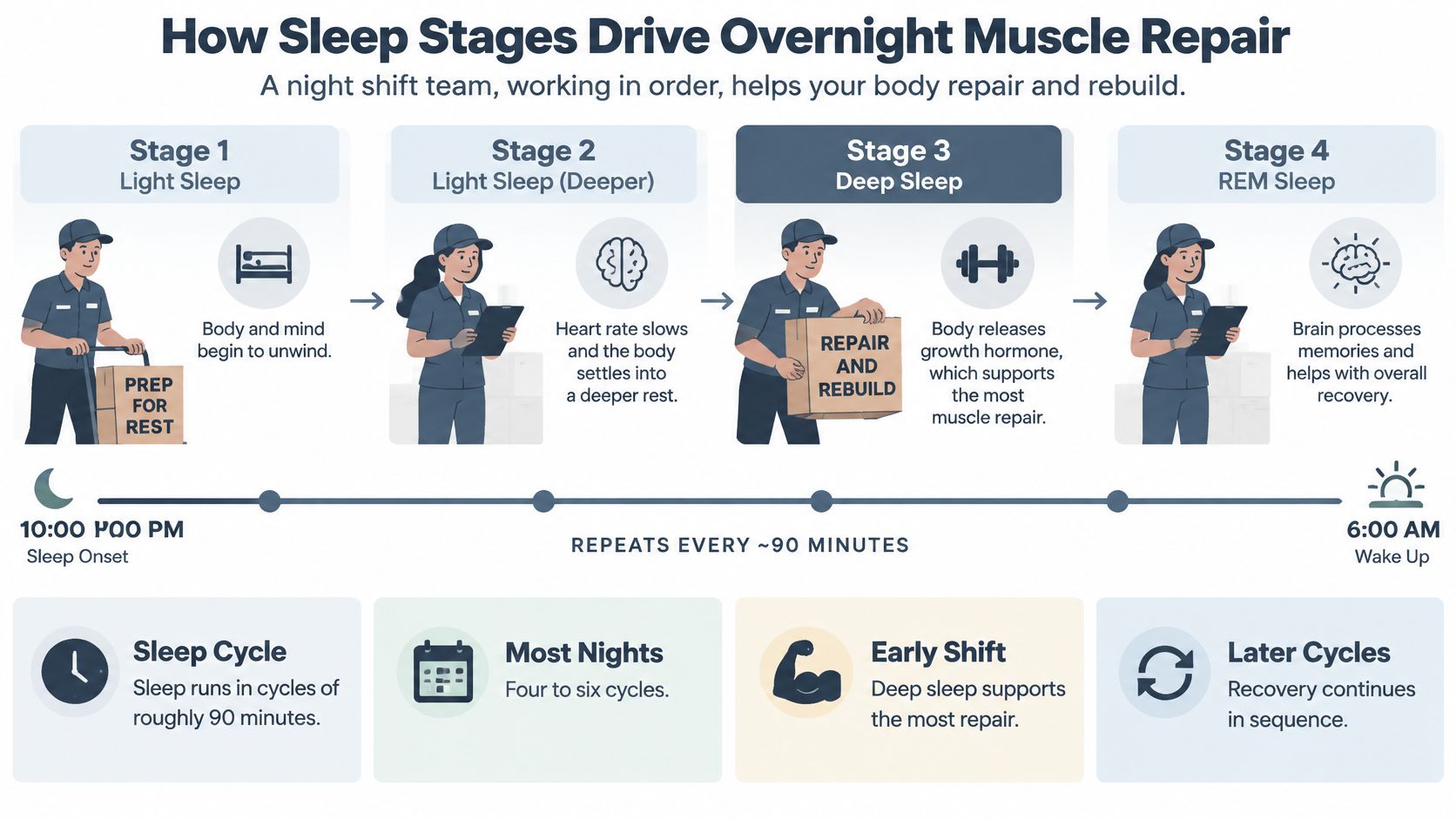
Lights out at 11 p.m. Within the first hour, your heart rate slows and you sink into the deepest sleep of the night. By early morning, you're spending more time in lighter stages and longer stretches of REM. The sequence matters, but it isn't a rigid timetable: people cycle through lighter sleep, deeper sleep, and rapid eye movement sleep, with brief awakenings sometimes interrupting the pattern.
This timeline illustrates the broad progression, not a schedule your body must follow precisely.
Early sleep and physical restoration
As you move into deeper non-REM sleep, your heart rate generally slows and your body settles into a less alert state. Slow-wave sleep is associated with growth hormone release, which participates in tissue maintenance and repair. The explanation of what slow-wave sleep means offers useful background on this stage.
Your muscles continually make and break down proteins around the clock, including while you're awake. Sleep supports repair that also happens during the day. It creates conditions that favor rebuilding, which is why deep sleep early in the night gets so much attention in recovery research.
Later in the night, REM periods tend to become longer. REM and other sleep stages contribute to learning and memory processes, including retaining practiced movement skills. Remembering a new lifting cue is a performance outcome. Rebuilding contractile tissue is a muscle-building outcome. Both relate to training, and a single short night can affect them differently.
What remains uncertain
The glymphatic system, a pathway involved in clearing substances from the brain, is an emerging part of the sleep discussion. Changes in fluid movement during sleep are scientifically interesting, and human evidence is still developing. Current research hasn't established that brain waste clearance directly accelerates muscle repair.
This video offers another way to visualize how the stages fit together across a night.
A stable bedtime protects a predictable sleep opportunity. Say you stay out unusually late over the weekend, then try to return immediately to your worknight schedule. You may not feel sleepy at the usual time, and that one restless night can't tell you exactly how much deep sleep you lost.
Watch for practical warning signs:
- Repeated waking: You spend substantial parts of the night awake.
- Unrefreshing mornings: Adequate time in bed still leaves you exhausted.
- Persistently unsettled sleep: Several nights feel light or disrupted, rather than one isolated night feeling different.
Treat these patterns as reasons to investigate sleep quality. None of them pinpoints a specific sleep-stage deficiency on its own.
What Short Sleep Does to Repair Hormones and Protein Synthesis
After one night without sleep, participants experienced a 21% increase in plasma cortisol, a 24% decrease in testosterone, and an 18% reduction in muscle protein synthesis, according to experimental findings summarized in this review of sleep and athletic physiology. Total sleep loss reaches into recovery biology itself.
The important qualifier is without sleep. These findings don't mean that waking briefly, going to bed late, or having an uncomfortable night produces the same changes. A single rough night and a full night awake sit at very different points on the same spectrum.
Follow the repair chain
Resistance exercise supplies a stimulus for adaptation. Dietary protein supplies amino acids, the building materials your body uses to make muscle proteins. Hormonal signals and other cellular processes then help regulate what happens to those materials.
Cortisol mobilizes energy under stress, and normal daily fluctuation is part of healthy function. A sustained stress-dominated environment, however, can favor tissue breakdown over rebuilding.
Testosterone supports anabolic signaling, the processes involved in building and maintaining tissue. A short-term change in its concentration is one input in a larger physiological picture, not a direct readout of muscle gained or lost.
Muscle protein synthesis is the step where amino acids are assembled into new muscle proteins. It is the actual construction work of maintaining and remodeling muscle tissue, the stage where training stimulus and dietary protein finally turn into structural change.
A protein-rich meal supplies the materials, and recovery conditions influence how efficiently your body puts them to use.
A controlled human study also found reduced post-meal muscle protein synthesis after sleep deprivation, supporting the idea of acute anabolic resistance, a weaker building response to feeding, in the experimental report on sleep deprivation and muscle metabolism. That is a pathway measurement, a sign that the building response slowed. It does not show that anyone visibly lost muscle overnight.
Repeated restriction is a separate concern
The pattern extends well past a single sleepless night. In healthy young men, five consecutive nights with four hours in bed reduced myofibrillar protein synthesis by approximately 19% compared with normal sleep in a controlled sleep-restriction study. Myofibrillar proteins are the contractile proteins that help muscles produce force, so this measurement speaks directly to the rebuilding of the tissue that does the work.
A lower synthesis rate answers a question about how muscle gets remodeled between sessions. That is a different question from how the next workout feels.
Consider a student athlete sleeping five hours nightly during exam week while continuing heavy lifting. They may complete every session and meet their usual protein intake, yet still have less favorable conditions for remodeling between workouts. The example illustrates the mechanism rather than a precise prediction for any one athlete.
Watch for soreness lasting longer than usual and familiar loads feeling harder. Neither pinpoints a hormone problem on its own, because illness, inadequate food, and excessive training can produce the same signals.
The practical conclusion: sleep belongs inside the repair process, alongside training and nutrition. One bad night is recoverable. A pattern of short nights undercuts the building work you already paid for in the gym.
How Much One Bad Night Really Hurts Training
You slept badly, and today is heavy leg day. Should you cancel, push through, or change the workout?
Start by separating a shortened night from complete sleep deprivation. A 2025 systematic review of 13 studies found that sleep loss commonly impaired some measures of strength, power, muscular endurance, and neuromuscular function, while maximum one-repetition strength was generally resistant to brief sleep loss.
That distinction matters. You might still move a heavy weight while feeling less coordinated, tiring earlier, or needing more effort to repeat the movement. Preserved maximal strength doesn't automatically mean the session is equally safe or productive.
Use the warm-up as a decision point
The following is a conservative coaching framework, not a validated medical threshold:
- After one shortened night: Keep the appointment with yourself if you feel capable, but cap intensity. Skip maximum attempts and technically demanding or high-risk work if your warm-up feels unstable.
- After three or more consecutive short nights: Consider removing one set from each main exercise and protecting additional sleep opportunity. Treat this as a temporary workload adjustment, not punishment for sleeping poorly.
- After severe sleep loss or marked sleepiness: Choose rest, easy movement, or a simple low-risk session. Don't force heavy lifting or drive to training when you're struggling to stay awake.
For example, replace an ambitious squat personal-record attempt with controlled, submaximal repetitions. If balance, bracing, or bar path deteriorates, switch to a more stable exercise or end the session.
Track function, not just willingness
Use movement quality, perceived exertion at a familiar load, and reaction time in routine drills as checks. You don't need a laboratory reaction-time test; repeatedly missing a familiar cue is enough reason to simplify practice.
Laboratory findings also have limits. Athletes juggle nutrition, stress, travel, training load, and opportunities to recover, so a severe experimental sleep protocol can't precisely predict every real-world session.
There's no universal number of recovery nights that guarantees you're fully restored. Resume harder work as sleep, alertness, and movement normalize. Judge patterns across several nights rather than allowing a single wearable sleep score to make the decision.
Whether Naps and Extra Sleep Help Recovery
An earlier bedtime and an afternoon nap solve different scheduling problems. Extending nighttime sleep protects a longer uninterrupted window for repair. A nap adds a separate rest period when your day allows one.
In a review of athletic sleep interventions, every included sleep-extension study improved physical-performance measures. Nap findings were mixed: five studies found benefits, three found no effect, and one reported a negative effect. That pattern supports trying sleep extension first, and it explains why nap results deserve a closer look before you build a plan around them.
| Option | Most useful situation | A sensible first test | Main limitation |
|---|---|---|---|
| Earlier bedtime | Your schedule repeatedly cuts nighttime sleep short | Add 30 to 45 minutes of sleep opportunity | More time in bed doesn't always become more sleep |
| Early-afternoon nap | You have a gap between work and training | One nap under 30 minutes on heavy training days | Grogginess or difficulty sleeping later may offset benefits |
| Late-day nap | Your schedule leaves no earlier opportunity | Keep it brief and finish well before your intended bedtime | It may interfere with falling asleep that night |
These test settings are starting points for an experiment, not proven optimal doses.
Decide what improvement means
Perceived recovery, next-day performance, soreness, hormone measurements, and muscle gain sit at different points on the same chain. A nap that leaves you refreshed has done something real, yet that refreshed feeling tells you nothing about protein synthesis, and a faster sprint is a performance result rather than a muscle biopsy. When a study reports that extra sleep "improved recovery," check which outcome it captured. The closer a measurement sits to directly tracked protein synthesis or measured muscle gain, the more weight a growth claim can carry.
Nap responses still vary from person to person, since daytime sleep can push bedtime later for someone prone to insomnia while a short nap leaves another person restored.
SleepHabits' guide to the best nap length for energy walks through duration and post-nap grogginess, and Groen's Fine Furniture on napping offers an accessible overview of daytime rest. Both are general lifestyle resources, so use them as background on daytime rest and weigh your training decisions against the athletic evidence above.
Test one change at a time
Pick a single option from the table and run it inside your two-week audit. Record morning soreness, total sleep, and one repeatable training marker, such as how a familiar warm-up load feels. Changing two variables at once leaves you guessing which one worked.
Nighttime sleep remains the foundation of recovery, with naps acting as a supplement around it. Neither sleep aids nor wind-down routines have earned a blanket promise of increased muscle growth, so keep the experiment focused on sleep opportunity itself.
Nutrients Linked to Recovery Sleep and What Evidence Shows
| Nutrient or habit | Evidence for overnight recovery | Practical use | Caveat |
|---|---|---|---|
| Casein protein, 20 to 40 g about 30 minutes before bed | A 2024 review reports higher overnight whole-body or myofibrillar muscle protein synthesis | Greek yogurt or cottage cheese as a pre-bed snack | Daily total protein still matters most |
| Magnesium, such as glycinate | Limited direct evidence for muscle recovery; findings are often small or indirect | Common in sleep products; check the label for dose | Check with a physician if you take medication |
| Dietary nitrate, such as beetroot | Evidence mainly concerns exercise blood flow rather than sleep repair | Beetroot juice earlier in the day, if already part of your nutrition plan | An overnight recovery benefit isn't established |
| Caffeine | Can delay sleep onset and reduce sleep depth | Avoid in the hours before bed | Sensitivity differs between people |
Casein has the clearest direct signal here for overnight protein synthesis. It's a slowly digested milk protein, so dairy foods can provide a practical alternative to a powder. Check the nutrition label rather than assuming that any small serving supplies the amount used in a study.
A pre-bed serving should contribute to your daily intake, not substitute for adequate food during the day. If you've barely eaten since breakfast, the first priority is a workable overall eating pattern, not perfect bedtime timing.
Separate a plausible mechanism from a demonstrated outcome
Magnesium participates in normal muscle and nerve function. That role makes it reasonable to include in a sleep product, yet it doesn't establish that the product accelerates post-workout repair. If your intake is already adequate, a supplement trial mostly tells you whether you fall asleep more easily, which says little about tissue rebuilding.
The same gap applies to nitrate. Supporting blood flow is biologically relevant, but it doesn't prove that taking beetroot before bed increases overnight muscle rebuilding. Be cautious when a product description moves directly from an ingredient's role in the body to a promised training outcome, because each step in that chain needs its own evidence.
The guide to muscle recovery supplements can help you sort claims by which outcome they measure. Use it to compare purposes and limitations rather than assemble a longer supplement stack.
Choose an option you can evaluate
If you want to try pre-bed nutrition, choose the food-based protein option with the clearest connection to the outcome you want. A one-week trial can show whether the snack fits your intake and sleep, not whether it changes muscle size. Note whether it sits comfortably, whether you wake during the night, and whether you still want it by day seven.
No nutrient cancels out a late coffee, a large late meal, or a drink at bedtime. Treat those as timing problems to fix directly rather than effects a supplement can undo.
Anyone with heart or blood-pressure conditions, sleep apnea, or prescription sleep medication should consult a physician before adding a supplement. Persistent insomnia also deserves assessment, not progressively stronger self-treatment.
Build an Evening Routine That Protects Recovery
A useful routine removes predictable obstacles to sleep. It doesn't need to be elaborate, and missing a step occasionally doesn't ruin your recovery.
The CDC's behavioral sleep guidance recommends consistent bed and wake times, a quiet and dark bedroom, removing light-emitting electronics, and avoiding large meals, nicotine, alcohol, and caffeine before bedtime. Turn those principles into actions you can repeat after training.
Make the sequence easy to follow
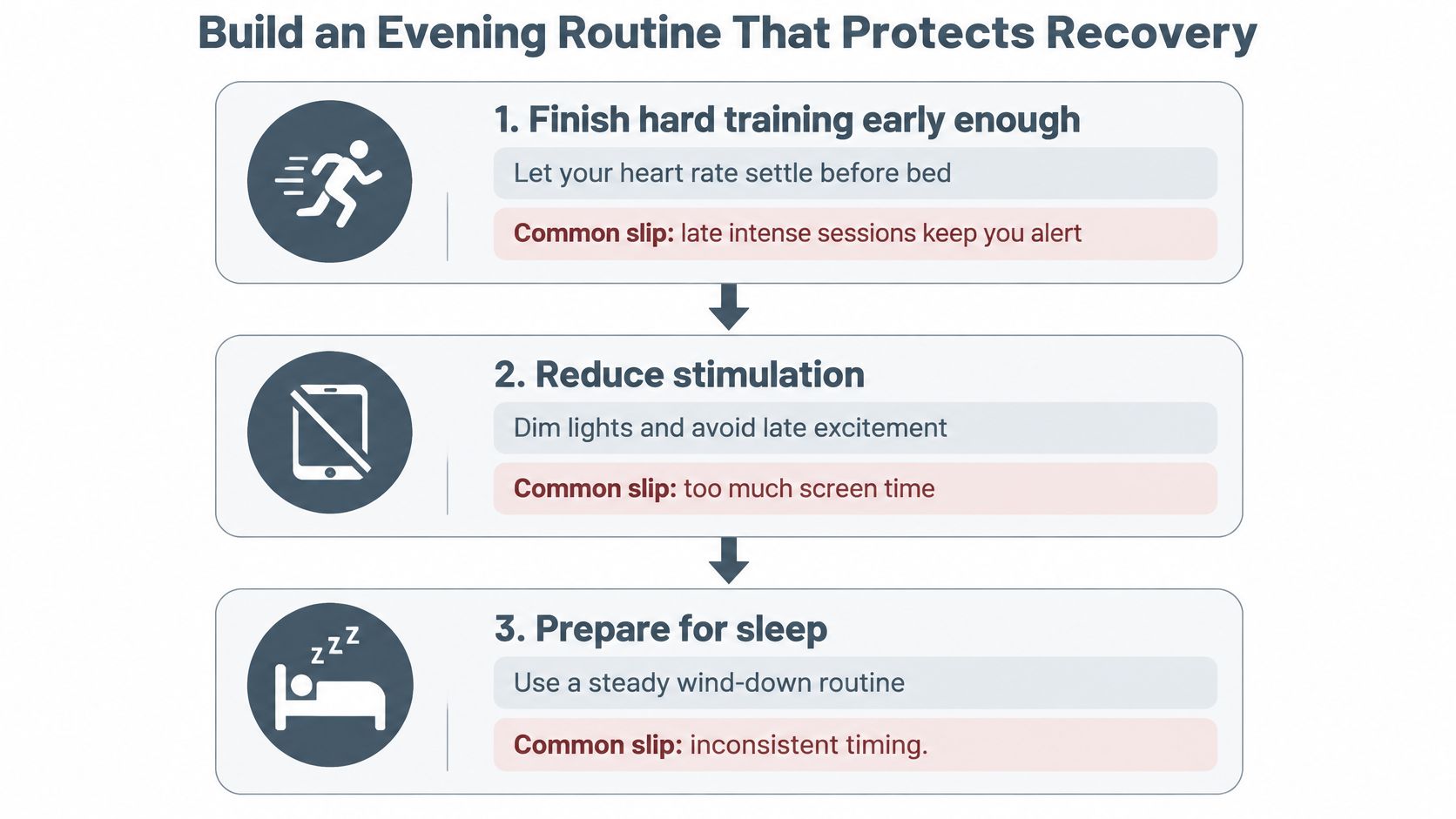
- Finish hard training with time to settle. Leave room for your heart rate and alertness to come down before bed. The common slip is letting a delayed session become an intense workout immediately before lights out.
- Use the protein option deliberately. If it suits your nutrition plan, have the casein-containing snack about half an hour before bed and avoid a large meal in the final few hours. The common slip is adding an uncomfortable amount of food because it's labeled recovery nutrition.
- Move caffeine earlier and avoid bedtime alcohol. If you're regularly alert at bedtime, start by dropping the late coffee or stimulant-containing pre-workout. Alcohol may make you feel sleepy without providing dependable sleep quality, so don't use it as a wind-down tool.
- Dim lights and park devices outside the bedroom. Set an alarm before putting your phone away, and use a separate alarm clock if necessary. A common slip is replacing work email with equally stimulating scrolling.
- Make the bedroom quiet, dark, and comfortably cool. Close curtains, reduce avoidable noise, and adjust bedding to prevent overheating. Don't turn temperature control into a search for a perfect number.
- Spend ten minutes on a quiet transition. Try comfortable slow breathing or write tomorrow's tasks in a notebook. Keep breathing unforced, and don't treat difficulty breathing through your nose as something to push through.
- Keep a dependable wake time. Make it an anchor rather than alternating late nights with improvised sleep-ins. If your schedule repeatedly prevents adequate sleep, change the evening workload instead of relying on willpower each morning.
This diagram groups the actions into a simple evening flow.
Keep optional extras optional
If scent helps mark the end of your day, the Aroma Warehouse guide to sleep oils offers ideas to explore. Fragrance isn't a muscle-repair treatment; skip it if it irritates your skin or breathing.
Our Restore+ Sleep Aid is melatonin-free and designed to work best within a nightly ritual that includes a cool room, nasal breathing, limited screens, and consistent sleep and wake times. It isn't a replacement for evaluating persistent sleep or breathing problems.
After a week, look for easier wind-down and fewer groggy mornings as signs the routine may suit you, not guaranteed results. The best routine is one you can follow without making bedtime another stressful performance task.
Start a Two-Week Sleep Audit Before Your Next Block
Treat sleep as something to measure before changing your training plan. In 2020, 35% of U.S. adults reported fewer than seven hours of sleep on average, according to the CDC's insufficient-sleep indicator, so a short baseline isn't unusual.
Record actual estimated sleep, not just time in bed. Each morning, log soreness and energy on a personal 1-to-10 scale; after training, note the session load and one familiar performance marker. These are practical tracking choices, not diagnostic cutoffs.
Use the log to make a decision
- Repeatedly short sleep: Add sleep opportunity and remove evening disruptions before relying on a long sleep-in.
- Several days of declining performance despite adequate hours: Consider a temporary reduction in training volume, then reassess fatigue and food intake.
- Persistent poor sleep or breathing symptoms: See a physician for loud snoring, gasping, or substantial daytime sleepiness.
For example, note whether a familiar lift feels harder after a run of short nights. Don't assume every sore morning came from sleep; compare training changes and stress too.
We recommend a sleep test as a starting point for building better sleep habits. A habit assessment doesn't replace medical evaluation when symptoms suggest a sleep disorder.
Choose one change tonight, such as charging your phone outside the bedroom, and log its effect over the next seven days. Keep the same log for the full audit so you can judge a pattern rather than a memorable morning.
SleepHabits offers educational resources and sleep-support products to help you build a more consistent nighttime routine. Visit SleepHabits to explore those resources, start with a sleep test, and choose a practical next step for protecting your recovery.