

You're in bed, watching a breathing-rate number on your wearable, and wondering whether a lower reading means you're sleeping better. It might reflect normal changes during sleep, but it can't tell the whole story. The useful distinction is between choosing a slower, comfortable breathing rhythm before bed and trying to make your breathing unusually slow after you've fallen asleep.
A short pre-sleep routine can be worth trying for relaxation and sleep continuity. It isn't a way to diagnose or treat sleep apnea, and a single breaths-per-minute reading shouldn't be treated as a sleep-quality score.
What Slow Breathing Actually Does While You Sleep
The phrase “slow breathing while sleeping” often blurs two different things. One is intentional paced breathing before sleep, when you're awake and can comfortably guide your breath. The other is the breathing pattern your body adopts on its own as you move through sleep stages. The first can be a wind-down habit. The second isn't something to force.
A study of healthy adults measured average breathing at 12.2 breaths per minute while awake, 12.3 during stage-2 sleep, and 12.4 during slow-wave sleep. In REM sleep, the average rose to 13.8 breaths per minute, alongside the irregular breathing associated with that stage. Those measurements show why it's inaccurate to assume that breathing becomes dramatically slower throughout all of sleep. (The Journal of Applied Physiology study)
What changed more clearly was ventilation, meaning the total amount of air moved per minute. It fell from 5.9 liters per minute while awake to 5.2 liters per minute asleep. The practical point is that lower ventilation during sleep doesn't necessarily mean a much lower breath count. Rate and depth are different parts of the picture.
Practical rule: Use paced breathing to settle before bed. Don't try to control your breathing once you're asleep.
A small controlled study offers a reason to test a pre-sleep routine, not to chase a low nighttime reading. People with self-reported insomnia completed a 20-minute session at 6 breaths per minute and were compared with a paced condition at 12 breaths per minute. After the slower session, objective sleep recordings showed improvements in sleep initiation and continuity compared with the faster-paced condition and baseline. The study supports a possible pre-sleep benefit, not a guarantee that every person will respond or that slow breathing prevents a sleep disorder. (The 2019 paced-breathing study)
Building a 20-Minute Pre-Sleep Breathing Routine
Try the routine before you turn out the lights, sitting in a chair or settled comfortably in bed. Dim the room, silence notifications, and put your screen aside. If anxious thoughts are part of your bedtime pattern, a practical guide to anxiety care from Total Mental Wellness may offer additional ideas for making the wind-down feel manageable.
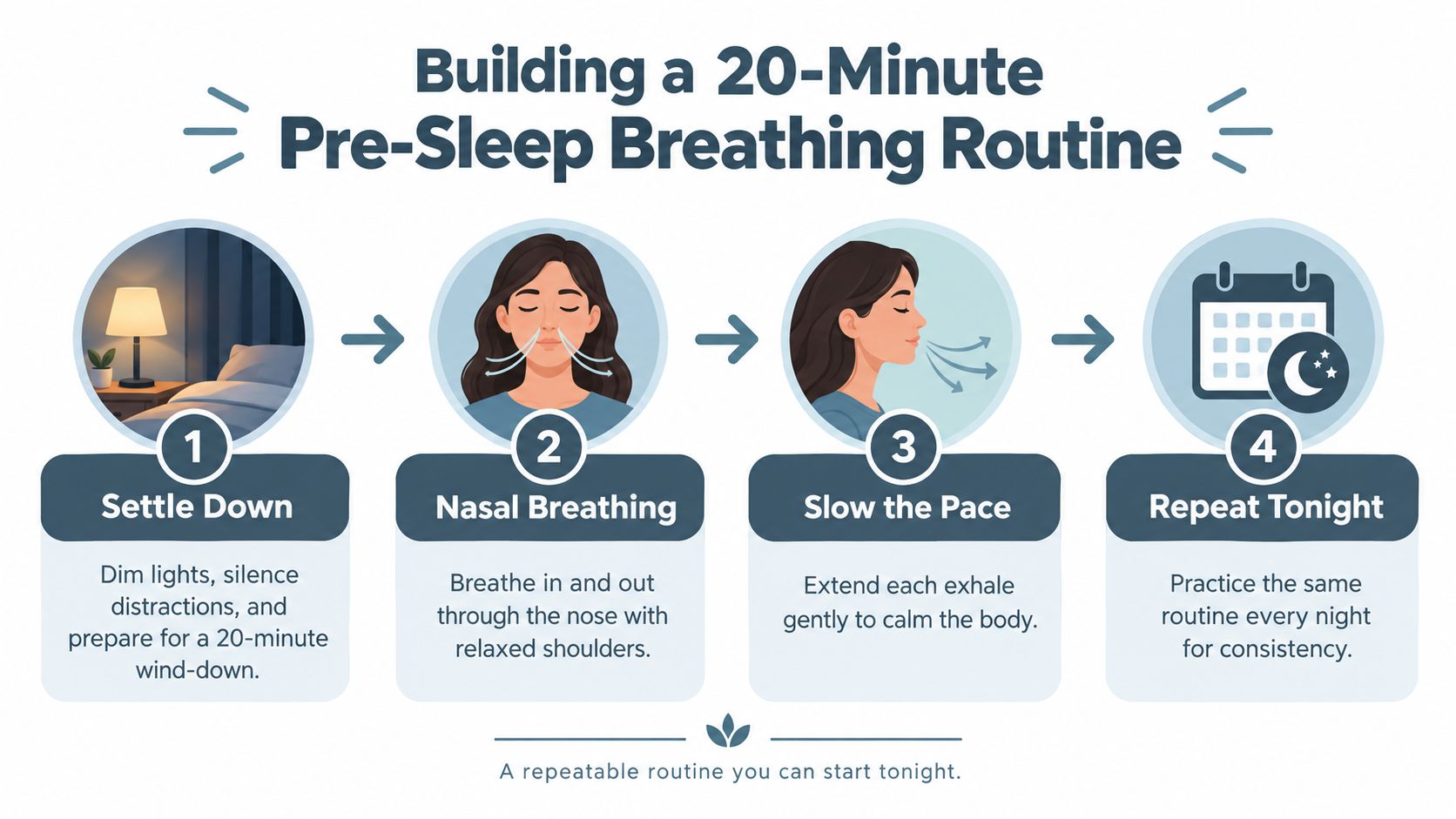
Settle in. Let your shoulders drop and unclench your jaw. Breathe normally for a moment before you begin counting. The aim is to make the practice feel easy enough to repeat, not to fill your lungs as much as possible.
Find a gentle rhythm. A pace of about 6 breaths per minute works out to roughly 10 seconds for one full inhale-and-exhale cycle. For example, breathe in gently through your nose, then let the exhale last a little longer if that feels comfortable. Don't hold your breath or strain to match an exact count.
Continue for 20 minutes. If counting distracts you, use a quiet timer or simple pacing cue. Notice whether your shoulders stay relaxed, your breathing feels smooth, and your attention settles. If you feel air hunger or discomfort, stop counting and return to natural breathing.
The study described above used bedtime practice and objective sleep recording, so its timing is relevant: the exercise was done before sleep rather than imposed during the night. Its findings don't establish that the routine will work for everyone. Track how you feel across several nights instead of deciding from one session.
If you're considering supplements alongside a wind-down routine, Restore+ Sleep Aid is described as melatonin-free support designed to support nitric oxide production, nervous-system regulation, and overnight oxygen delivery. Treat a product as optional, not as a replacement for a comfortable breathing practice or medical advice.
Training Nasal Breathing for Quieter Nights
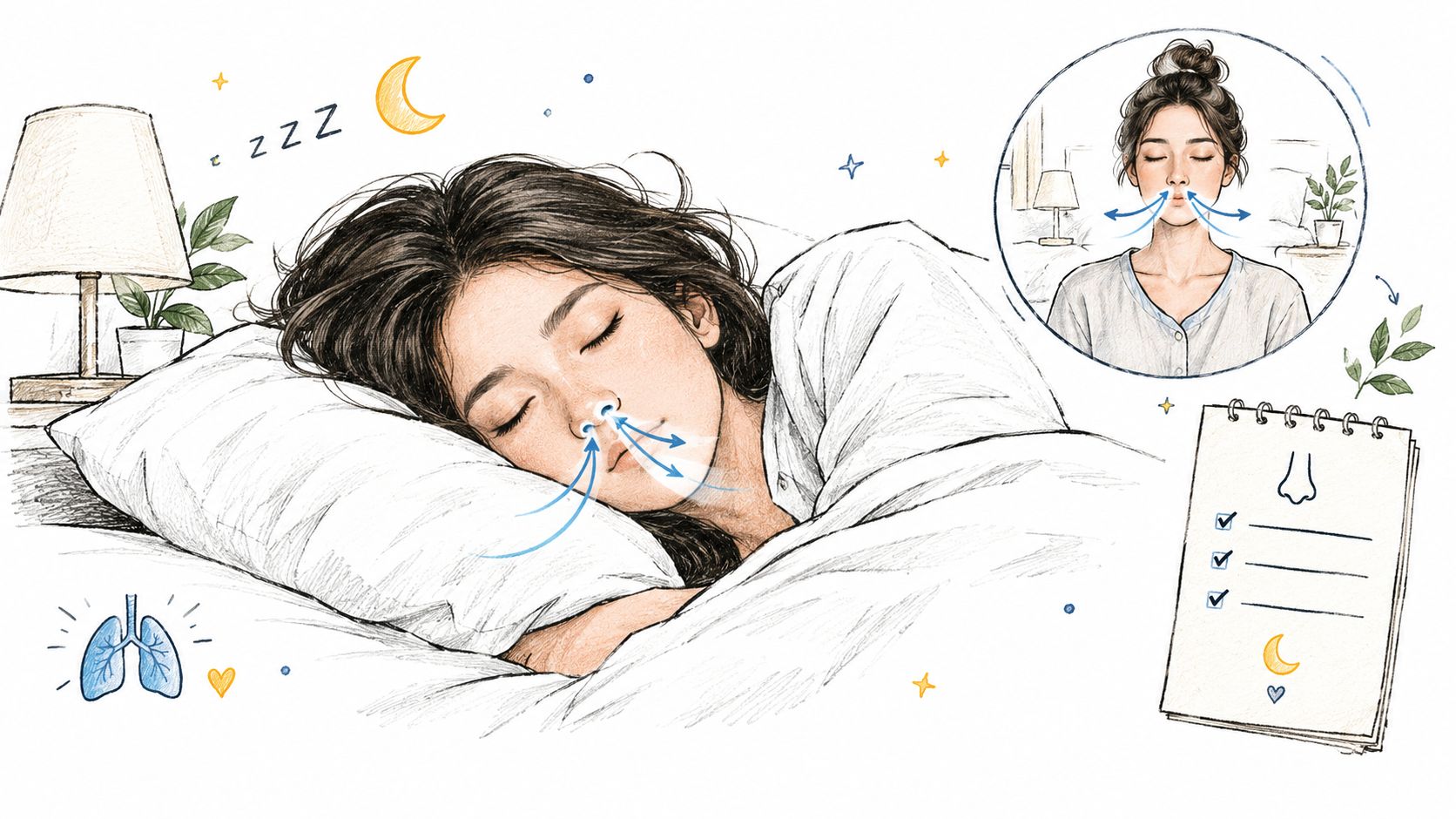
If your mouth tends to fall open at night, start by noticing the habit while you're awake. Sit with your jaw relaxed and lips gently together, then check whether you can breathe comfortably through your nose. Repeat the check while walking or doing a quiet task. The aim is awareness, not forcing your mouth closed when your nose feels blocked.
A clinical review describes how mouth breathing during sleep can raise total airway resistance, narrow the pharyngeal airway, and increase movement of the soft palate and surrounding tissue. Those mechanics can contribute to snoring or breathing disturbance. They don't mean that every person who wakes with a dry mouth has a sleep disorder, but persistent congestion, loud snoring, or observed pauses deserve more than a breathing drill. (The clinical review of mouth breathing during sleep)
For background on the differences between the two routes, a family's guide to healthier breathing can help you understand the basic mechanics. At bedtime, notice whether one nostril feels blocked, whether allergies or congestion are affecting airflow, and whether your position seems to make breathing less comfortable. Address an obvious reversible issue appropriately rather than treating mouth breathing as a willpower problem.
Once daytime nasal breathing feels easy, carry that relaxed pattern into your wind-down. Keep your lips gently together only if air moves freely through your nose. If you're learning the habit, these nasal breathing techniques offer another set of practical cues.
A short video can provide another visual explanation of nasal and mouth breathing:
Mouth Tape is designed to encourage nasal breathing by keeping the lips comfortably sealed during sleep. Don't use tape to overcome a blocked nose, breathing difficulty, or suspected sleep apnea. If you can't breathe comfortably through your nose, leave the tape off and address the reason for the obstruction.
Choosing Tools and Habits That Support Nasal Breathing
The right option depends on what is affecting sleep. Paced breathing can provide a calming wind-down before bed, but it does not clear a blocked nose. Nasal strips are designed to support airflow through the nasal passages, though they may not address the cause of persistent snoring. Sleep position and bedroom conditions can improve comfort, but they cannot guarantee that breathing symptoms will resolve.
| Option | Main Purpose | Key Limitation |
|---|---|---|
| Pre-sleep paced breathing | Create a calm, repeatable wind-down | Doesn't treat obstruction or diagnose a breathing disorder |
| Nasal strips | Support airflow through the nasal passages | May not address the cause of persistent snoring |
| Mouth tape | Encourage nasal breathing when airflow is comfortable | Isn't appropriate if the nose is blocked or breathing is difficult |
| Sleep position and bedroom conditions | Adjust comfort and reduce avoidable irritants | May not resolve ongoing breathing interruptions |
A small overnight study shows why a breathing aid shouldn't be treated as a universal snoring fix. Fourteen men with chronic snoring used a device intended to prevent mouth breathing and require nasal breathing. Sleep-disordered breathing events decreased from an average of 24.7 to 16.1 per hour, while average snoring frequency and intensity, sleep architecture, and arterial oxygen saturation did not change. (The overnight nasal-breathing device study)
SleepHabits offers Mouth Tape in two formats: The X, a lightweight hypoallergenic tape for sensitive skin, and The Roll, a hydrating silicone tape. The product pages state that both are third-party lab tested and designed to encourage nasal breathing. Mouth tape may suit a routine when nasal airflow is comfortable, but it does not replace assessment of persistent symptoms.
For an overview of options and their intended uses, see this guide to nasal breathing aids. If snoring continues, or someone notices pauses or gasping, seek medical advice instead of adding more devices.
Tracking Your Progress and Fixing Common Setbacks
A wearable's breathing-rate estimate can be interesting, but it's not enough to judge whether a routine is helping. Keep a simple morning note for one to two weeks: how long it seemed to take to fall asleep, whether you remember waking, how rested you feel, and whether your mouth feels dry. Look for a pattern across nights, not a verdict from one reading.
Change one thing at a time. If a pace feels too demanding, test a comfortable rhythm somewhere in the 5-to-7-breaths-per-minute range, a range used in individualized HRV-guided practice. Select the pace that feels smooth rather than assuming one number is ideal for everyone. In a pilot protocol, participants tested rates within that range and selected a rate based on their recorded HRV response and the smoothness of the breathing pattern. (The resonant-frequency breathing protocol)
A useful session should feel relaxed. If you're fighting for air, it's no longer a wind-down.
Common snags usually call for a small adjustment:
- You drift off mid-session. That's not a failure. Practice sitting in a chair, or end the session when you're sleepy.
- You feel air hunger. Stop pacing, breathe normally, and try a less slow rhythm another time. Don't compensate with large, forceful breaths.
- The exhale feels uncomfortable. Let it return to a natural length instead of stretching it to hit a count.
- A device irritates your skin or makes breathing feel restricted. Remove it. Comfort and free airflow matter more than sticking to a tool.
Avoid breath-holding and over-breathing. If you use HRV biofeedback, it can help identify a personally comfortable rate, but you don't need a device to practice gently. The aim is a repeatable wind-down and a clearer record of whether sleep feels different, not perfect compliance with a target.
When Slow Breathing Signals a Medical Concern
A low average breathing rate can't tell you whether breaths are shallow, whether breathing pauses repeatedly, or whether oxygen levels are dropping. A nightly average can smooth over brief but important interruptions. That's why breaths per minute is an incomplete signal, not a stand-alone safety test.
Slow breathing during sleep can be normal, but unusually low or disrupted breathing can also be associated with obstructive or central sleep apnea, sedatives, opioids, alcohol, COPD, neurological disease, heart failure, or other medical conditions. If a wearable shows an unexpected pattern, review trends rather than reacting to one night, and consider whether medication, alcohol, or symptoms could be relevant. Don't try to correct a concerning pattern by making your breathing exercises slower.
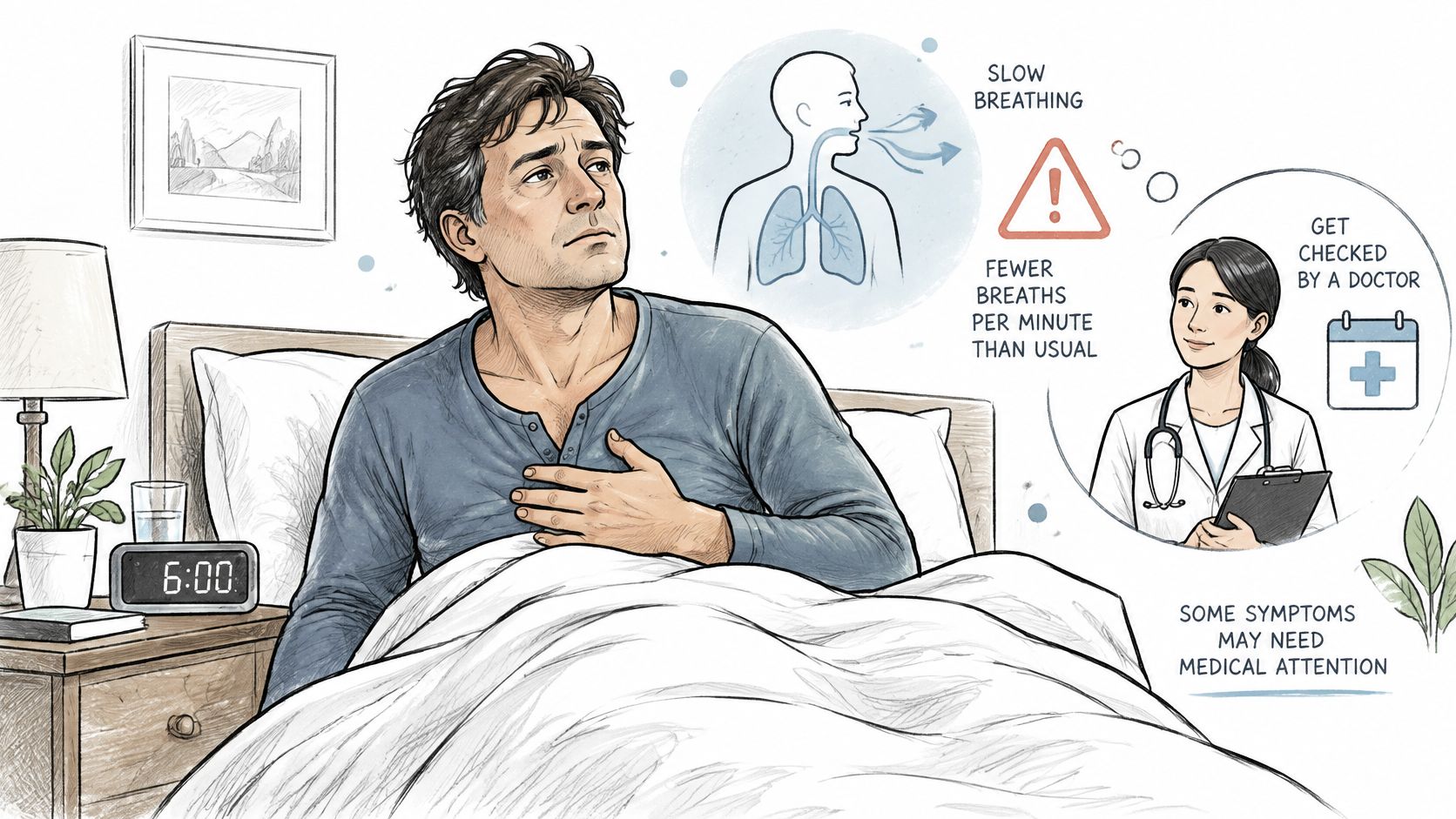
Arrange medical assessment for loud snoring, witnessed pauses, morning headaches, unexplained abnormal breathing, or persistent daytime sleepiness. A partner's observation may help describe what happens during sleep, but it can't replace a clinical evaluation. This overview of men's health and sleep apnea provides additional context about symptoms and sleep apnea concerns.
Seek urgent help for worsening breathing difficulty, blue or gray skin, chest pain, seizures, or loss of consciousness. These symptoms aren't a cue to try another breathing pace. If you're concerned about shallow or interrupted breathing, read about shallow breathing in sleep as background, then contact a healthcare professional. Breathing exercises should never be used to mask warning signs.
Your First Week of Slow Breathing at Night
Keep the first week simple. Use the breathing session as a wind-down practice, pair it with a brief daytime check of nasal comfort, and write down a few observations in the morning. You're looking for a routine you can repeat and a trend you can interpret, not a perfect breathing score.
- Night one: Settle into a comfortable position and try the 20-minute pre-sleep routine. Stop if the pace feels uncomfortable.
- During the day: Pause once to notice whether you can breathe comfortably through your nose with your jaw relaxed.
- Each morning: Record how sleep onset felt, whether you recall waking, and how rested you feel. Add a note if your mouth feels dry.
- Later in the week: Keep the same pace if it feels smooth. If it doesn't, adjust within the comfortable range described above rather than forcing a slower count.
- At the end of the week: Look for a consistent change in your notes. If breathing symptoms, snoring, or daytime sleepiness concern you, contact a clinician rather than extending the experiment.
For readers who want a nasal-breathing aid alongside the routine, SleepHabits' tape and nasal strips are options designed to encourage nasal breathing or support nasal airflow. They're not a solution for obstructed breathing or suspected sleep apnea. Choose tools only when you can breathe comfortably and stop using anything that causes irritation or restriction.
Tonight, set a bedtime reminder for your first session, place your phone out of reach, and begin with a pace that feels easy.
SleepHabits offers nasal-breathing tools, including mouth tape and nasal strips, that can complement a comfortable pre-sleep breathing routine. Visit SleepHabits to explore those options and build a wind-down that suits your needs.