

You wake up with a dry mouth, a blocked nose, and the familiar feeling that sleep happened, but recovery didn't. Perhaps you spent the night breathing through your mouth, or you're wondering whether a supplement marketed for circulation can also affect exercise, oxygen delivery, or nighttime breathing. The question behind all of these concerns is simple: what does increasing nitric oxide do?
Nitric oxide, often shortened to NO, is a signaling molecule that helps blood vessels relax. When more NO is available, vessels can widen, resistance to blood flow can fall, and oxygen can reach tissues more effectively. That process matters during movement, but it also matters while you're lying still and your airway, lungs, blood vessels, and nervous system are coordinating recovery.
The most useful way to understand NO is to follow it from vessel biology into everyday habits. You'll see how it changes circulation, why nasal breathing delivers more NO than mouth breathing, what sleep research can and can't tell us, and where supplements may create problems instead of solving them.
Introduction to What Increasing Nitric Oxide Means for Your Body
Nitric oxide doesn't work like a stimulant that forces the body into a higher gear. It acts more like a local traffic signal. Near blood vessels, it tells the surrounding smooth muscle to relax, giving blood more room to move through the vessel. That can support circulation and oxygen delivery without directly creating energy or replacing the need for healthy sleep.
The distinction matters because “increasing nitric oxide” can mean several different things. You might increase NO availability through nasal breathing, dietary nitrate, exercise-related blood flow, or a concentrated supplement. These approaches don't have identical effects, and a stronger signal isn't automatically a better signal.
The body also uses NO in more than one setting. In the cardiovascular system, it helps regulate vascular tone and arterial flexibility. In the lungs and upper airway, NO-related signaling is connected with pulmonary tone and breathing physiology. Sleep research is beginning to examine how nitrate intake, exhaled NO, airway inflammation, and sleep-disordered breathing interact, but the evidence doesn't support treating NO as a universal sleep cure.
The practical promise: more available nitric oxide can help vessels relax and improve perfusion, while nasal breathing may increase the NO available during ordinary breathing.
That gives you a grounded starting point. The goal isn't to chase the highest possible NO reading. It's to understand whether your chosen habit supports the outcome you want, such as steadier circulation, comfortable exercise, or more restorative nights.
How Your Body Makes and Uses Nitric Oxide
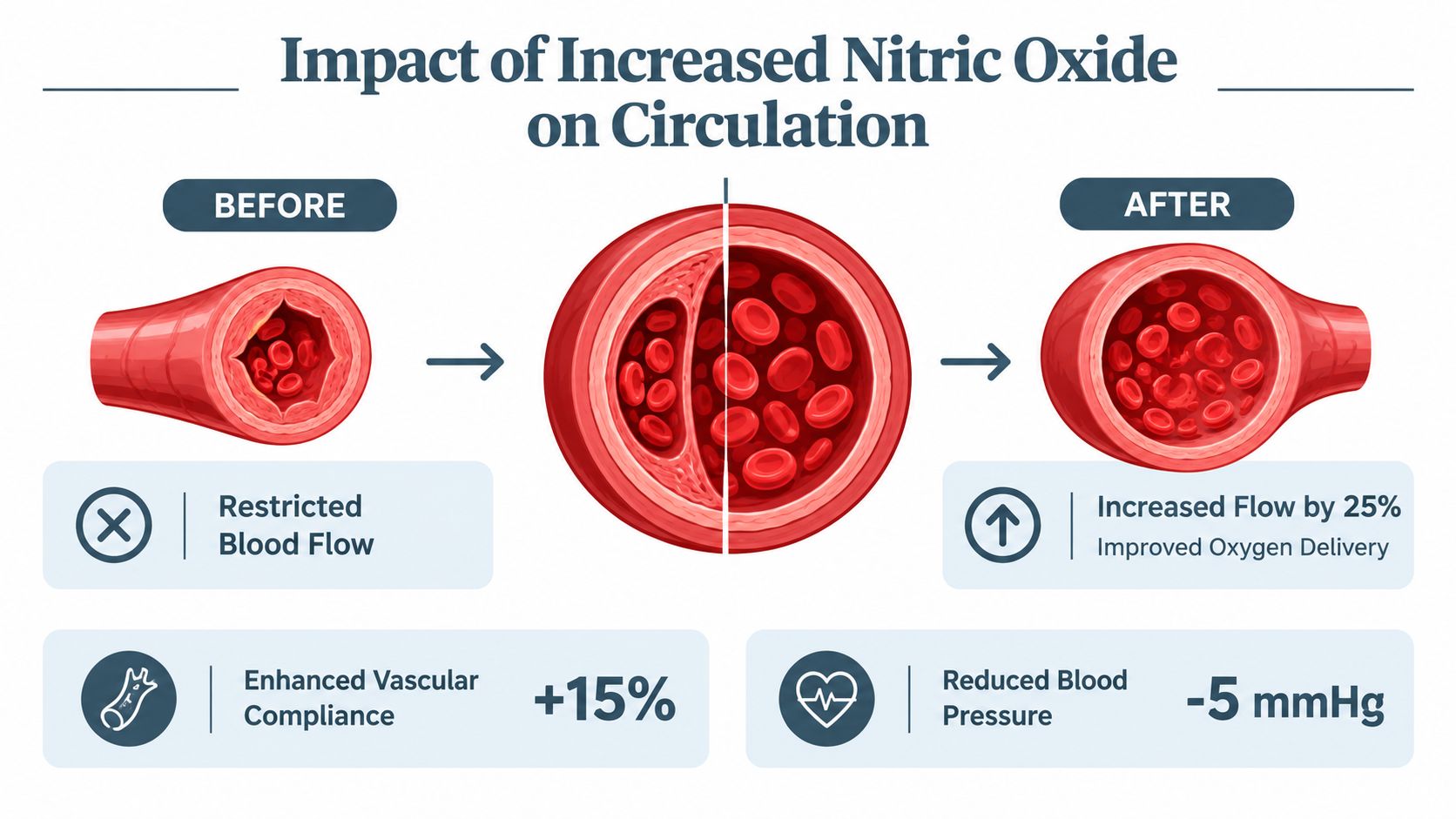
Blood vessels adjust their width constantly as tissues need more or less blood. The endothelium, the thin inner lining of each vessel, releases nitric oxide as one signal for the surrounding smooth muscle to relax. This local control helps match circulation with changing demands, including those created by movement and recovery during sleep.
NO moves from the endothelium into nearby vascular smooth muscle. It activates soluble guanylate cyclase, an enzyme that raises cyclic GMP, or cGMP. That messenger lowers intracellular calcium, weakening the signal that keeps the muscle contracted. The vessel wall then relaxes.
The sequence is local rather than a single body-wide switch. A chemical message changes muscle tension, the vessel offers less resistance, and blood can reach the tissue supplied by that vessel more easily. This can support oxygen delivery, but it does not create oxygen or replace healthy breathing and sleep.
The pathway in plain language
The process follows a connected chain:
- NO becomes available. The body makes it through its own signaling systems. Dietary nitrate can also contribute to NO bioavailability through the nitrate-to-nitrite pathway.
- NO enters nearby smooth muscle. Because its action is local, it can affect a vessel close to where the signal was produced.
- Soluble guanylate cyclase switches on. cGMP rises inside the smooth-muscle cell.
- Calcium falls inside the cell. The contraction signal becomes weaker.
- The vessel relaxes. Lower resistance makes it easier for blood and oxygen to reach active tissue.
The practical point is delivery, not “more oxygen in the blood.” Oxygen may already be present, while narrowed or poorly responsive vessels limit how effectively it reaches muscles, organs, or the brain.
This pathway also operates in pulmonary vessels. NO-related relaxation can moderate hypoxic vasoconstriction, in which vessels tighten as oxygen availability falls. During sleep, steady nasal breathing may support this biology because the nasal passages produce NO, and breathing through the nose can deliver more of it toward the lungs than mouth breathing. That does not make NO a cure for sleep-disordered breathing, but it explains why nighttime airway function and vascular recovery can be connected. This review of nitric oxide and vascular signaling describes the soluble guanylate cyclase, cGMP, calcium, and smooth-muscle pathway in detail.
What Happens to Blood Flow and Circulation When You Increase Nitric Oxide
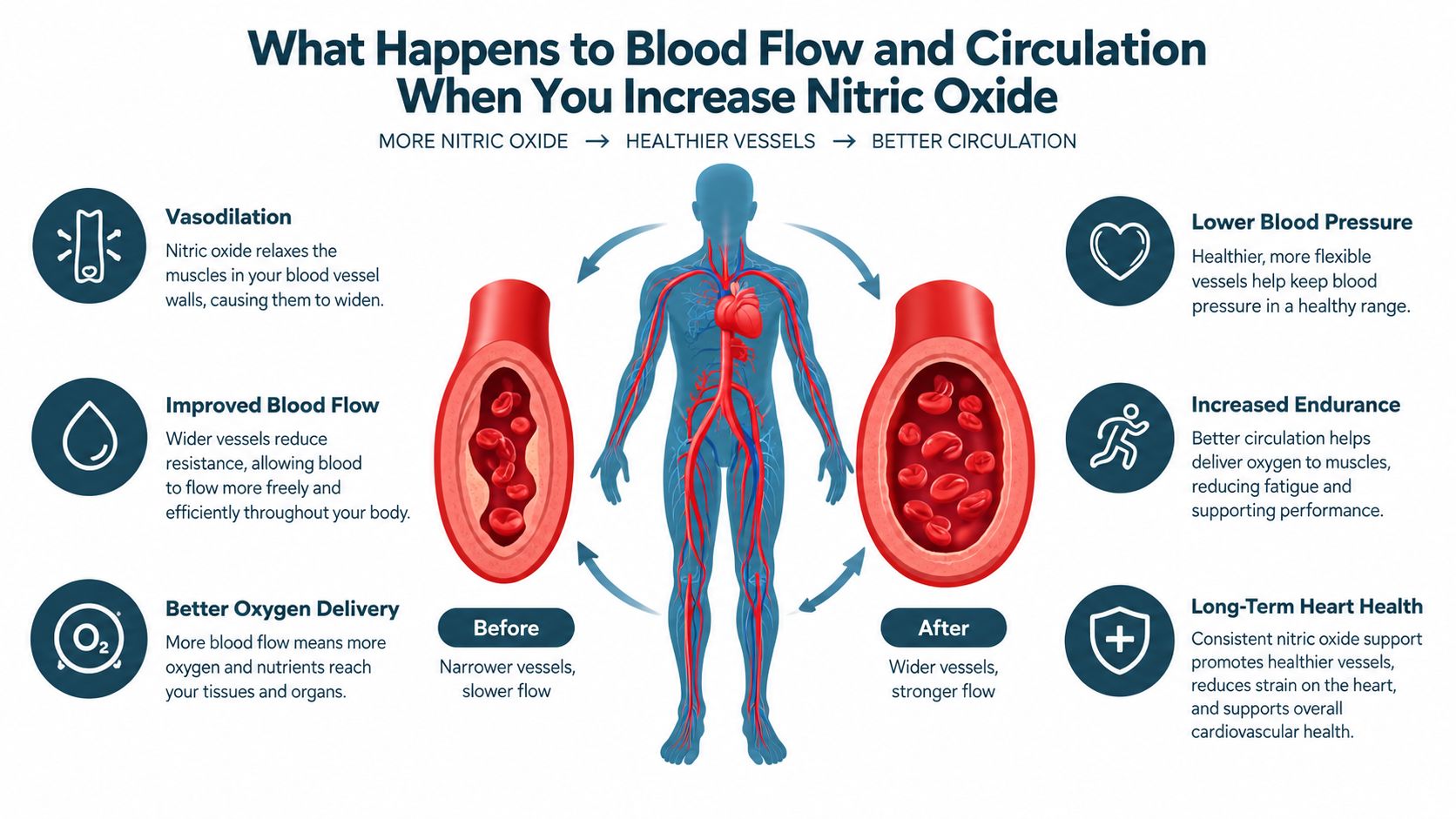
After a night of shallow or mouth breathing, circulation may have to work harder to match oxygen delivery with the body's needs. Increasing nitric oxide, or NO, supports that delivery system primarily through vasodilation. When a vessel relaxes, blood can move with less resistance, which may improve perfusion and reduce the pressure needed to maintain flow. NO also supports vascular compliance, the ability of arteries and other vessels to accommodate changing blood flow.
Human studies show these effects under specific conditions. In a 2014 clinical study involving hypertensive patients, an oral nitric oxide supplement acutely lowered blood pressure and improved vascular compliance. The reported mechanism was smooth-muscle relaxation, which can increase blood flow and oxygen delivery to particular vascular beds. The findings are summarized in this clinical review of nitric oxide and vascular function.
That result does not mean every NO product will lower blood pressure. It shows that an acute change in NO availability can produce measurable vascular effects in a studied group. Your response may vary with baseline vascular health, the form of NO support, medications, and dose.
Why arterial flexibility matters
In a separate 2019 study of healthy older adult males, acute dietary nitrate supplementation increased plasma nitrite, a marker of NO bioavailability, and improved flow-mediated dilation in the leg's conduit vessels after a single dose. Flow-mediated dilation measures how well a vessel responds when blood flow rises. The finding suggests that vascular responsiveness can change measurably after an acute dietary intervention.
Arterial flexibility matters because circulation must adjust as you stand, walk, exercise, digest food, or sleep. A responsive vessel can match delivery with demand more effectively. A less responsive vessel may need greater pressure to maintain the same flow, which can make overnight cardiovascular recovery less efficient.
The connection also reaches nighttime breathing. Nasal passages produce NO, and nasal breathing can deliver more of it toward the lungs than mouth breathing. That added delivery does not treat sleep-disordered breathing, yet it helps explain why nasal airflow, vascular function, and recovery can influence one another during sleep.
Nitric oxide became central to cardiovascular biology through several milestones. Researchers documented a direct vasorelaxant effect in 1979, followed by the discovery of endothelium-dependent relaxation in 1980 and 1998 Nobel Prize recognition of NO as a signaling molecule. This historical account of nitric oxide's medical development places those milestones in context.
How Increased Nitric Oxide Supports Exercise Performance and Overnight Recovery
During a steady run, working muscles need more oxygen and nutrients while carbon dioxide and other waste products move away. Nitric oxide helps the vascular system adjust to that changing demand. It does not create endurance by itself. It supports the delivery network that endurance relies on, much like widening a route when traffic increases.

An active adult may describe this as a less constricted feeling during continuous movement, although sensations cannot reliably show how much NO is present. The physiological point is clearer: NO-mediated relaxation can lower vascular resistance and help direct oxygenated blood toward tissues whose demand is rising. During low-oxygen conditions, related signaling can also oppose excessive hypoxic vasoconstriction and help maintain perfusion. The exercise implications fit with broader exercise recovery research, where circulation is considered alongside training load and rest.
From daytime movement to nighttime repair
Recovery continues after training ends. During sleep, the body coordinates breathing, cardiovascular tone, temperature control, immune activity, and tissue repair. Blood flow and oxygen delivery must keep adapting as those processes change through the night.
Breathing route adds an often-missed part of this picture. The nasal passages produce nitric oxide, and nasal breathing can deliver about twice as much nasal NO toward the lungs as mouth breathing. That does not treat snoring or sleep apnea, but it helps explain why nighttime breathing, vascular regulation, and recovery can affect one another. Sleep quality also reflects the conditions that support stable breathing and circulation, so NO levels are one part of a larger recovery system.
Athletes building a broader routine can compare breathing habits with sleep recovery for athletes. They can also review active recovery methods for athletes and place NO-supportive habits beside rest, mobility, and sensible training choices. One molecule should not carry the whole recovery plan.
Persistent mouth breathing at night may prompt attention to nasal comfort and possible airway problems. Mouth Tape is designed to gently encourage nasal breathing by keeping the lips comfortably sealed. Do not use it to force nasal breathing through a blocked nose or to conceal symptoms that need medical evaluation.
A short visual explanation connects vascular biology with movement and oxygen delivery:
Nasal Breathing Sleep and Nitric Oxide Delivery in Real Life
You may notice that mouth breathing leaves your mouth dry, while relaxed nasal breathing feels quieter and more controlled. The difference also matters biologically. The nose is a local source of nitric oxide, and a human breathing study measured exhaled NO at 141 ± 17 nL/min/m² during nasal breathing, compared with 68 ± 6 nL/min/m² during mouth breathing, with p < 0.001 for the comparison. In practical terms, nasal breathing can expose the airways to substantially more nasal NO during ordinary breathing. See the human study of nasal nitric oxide for the reported findings.
| Measure | Finding | What It Means for You |
|---|---|---|
| Nasal versus mouth breathing | Nose breathing produced 141 ± 17 nL/min/m², while mouth breathing produced 68 ± 6 nL/min/m². | Nasal breathing exposes you to substantially more nasal NO than mouth breathing. |
| Breathing flow | Nasal NO output is flow-dependent, and one physiology study reported output four-fold greater at higher inhalation flow than exhalation flow. Respiratory physiology research | Slow, controlled nasal breathing may help retain nasal NO compared with rushed airflow. |
| Sleep duration | Adults sleeping 6 to 8 hours had FeNO of 17.3 ± 14.9 ppb, compared with 16.0 ± 13.0 ppb for less than 6 hours and 15.9 ± 12.7 ppb for more than 8 hours. Sleep-duration study | The association was non-linear, with roughly 7 hours as the observed turning point, not a universal prescription. |
| Obstructive sleep apnea | Nasal NO was 76.9 ± 26.0 ppb in severe OSA and 47.9 ± 22.0 ppb in controls. After nasal CPAP, it fell from 81.9 ± 31.2 ppb to 53.7 ± 27.2 ppb. OSA study | NO measures may reflect upper-airway inflammation and response to airway support. |
Why pace and airway comfort matter
Nasal NO output changes with airflow. Research has found strong flow dependence, and nasal NO concentration was inversely correlated with transnasal flow rate. The practical lesson is limited but useful: comfortable, slower nasal breathing may retain more nasal NO than fast, forceful breathing. A calmer flow also makes nasal breathing easier to sustain before sleep.
Sleep duration shows another association. In a large U.S. adult study, FeNO rose by 1.09 ppb for each additional hour of sleep up to 7 hours, then fell by 0.71 ppb per hour after that point. This pattern does not prove that changing sleep duration will automatically raise NO or improve sleep. It suggests that sleep length and airway-related NO measures may follow a curved relationship rather than a simple “more is always better” rule. For a practical guide, read about the power of nasal breathing.
Nasal congestion can interrupt this pattern by forcing airflow through the mouth. Nasal Strips are designed to gently open the nasal passages and support smoother airflow. They do not diagnose or treat the cause of obstruction. Persistent blockage, loud snoring, gasping, or witnessed breathing pauses deserve clinical evaluation.
For runners, controlled breathing during exertion can support comfort and pacing. These running breath techniques for better speed apply during training, while nighttime nasal breathing requires separate attention to airway openness and sleep quality. If breathing remains difficult despite a clear effort to use the nose, address the underlying airway problem rather than forcing the technique.
Evidence Backed Ways to Increase Nitric Oxide Safely
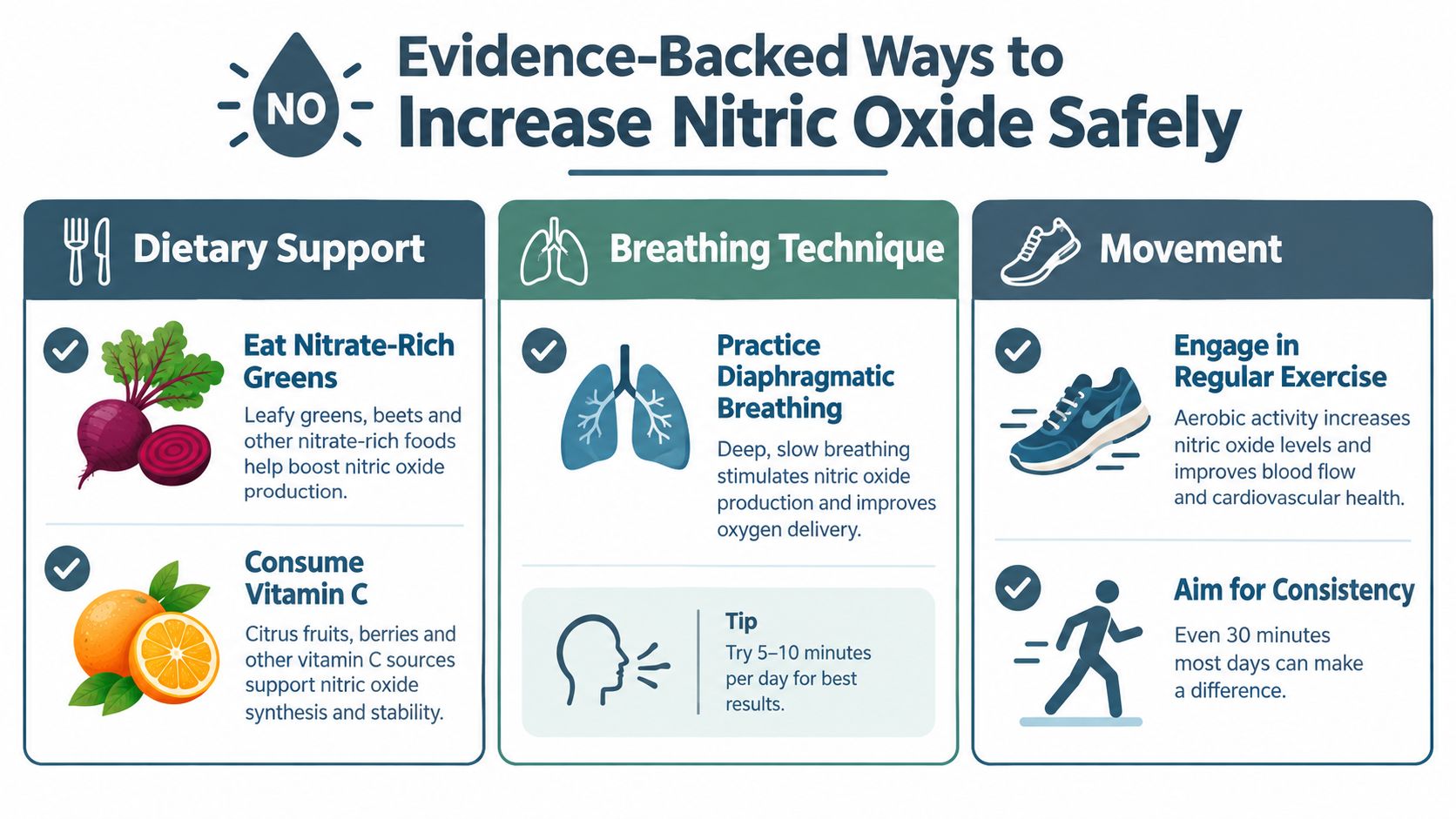
The safest approach starts with habits that support normal physiology rather than chasing a dramatic short-term effect. Food-based nitrate, regular movement, and comfortable nasal breathing can fit together, but they serve different purposes.
Start with food and movement
Dietary nitrate can increase NO bioavailability through the nitrate-to-nitrite pathway. A food-first routine can include nitrate-rich vegetables such as leafy greens and beetroot, alongside a generally varied diet. The available evidence supports dietary nitrate as a meaningful route to vascular effects, but it doesn't justify promising the same result for every person or every product.
Movement provides another signal. As blood flow rises through active vessels, the endothelium responds to changing flow conditions, supporting NO-related vascular regulation. Choose activity you can repeat consistently, whether that means walking, cycling, swimming, or structured training.
Use breathing as a low-tech experiment
Try a few minutes of relaxed nasal breathing before bed. Keep the pace gentle, let the diaphragm move naturally, and avoid turning the exercise into forceful breath-holding or rapid breathing. If your nose is blocked, address the obstruction rather than just trying harder.
A useful evening sequence might look like this:
- Settle the airway: Reduce congestion triggers and choose a comfortable sleeping position.
- Slow the breath: Breathe through the nose without straining for more airflow.
- Keep the routine consistent: Observe morning dryness, snoring, awakenings, and alertness over time.
- Escalate symptoms appropriately: Seek evaluation for gasping, breathing pauses, or persistent daytime sleepiness.
For readers comparing concentrated products, this guide to nitric oxide supplements can help distinguish dietary support from L-arginine or L-citrulline products. Restore+ Sleep Aid is described by its manufacturer as a melatonin-free product designed to support nitric oxide production, nervous-system regulation, and overnight oxygen delivery. Those product claims shouldn't replace independent medical guidance or a proper sleep evaluation.
Risks Myths and When Increasing Nitric Oxide Is Not Helpful
More nitric oxide isn't always better. The same vasodilation that may support circulation can become uncomfortable or unsafe when the signal is excessive, poorly timed, or combined with medication that also lowers blood pressure.
Independent reviews describe possible adverse effects from L-arginine and L-citrulline, including nausea, bloating, diarrhea, palpitations, headache, and blood-pressure drops. High intakes or combinations with certain drugs may create excessive vasodilation and low blood pressure, so anyone using blood-pressure medication or other vasoactive drugs should speak with a clinician before taking concentrated NO supplements. See this review of L-arginine and L-citrulline safety.
Sleep and respiratory applications also need careful interpretation. Research has connected NO measures with sleep duration, airway inflammation, pulmonary tone, and obstructive sleep apnea, but those findings don't prove that increasing NO alone will fix insomnia, snoring, or nighttime breathing. In severe OSA, for example, nasal NO changed with disease severity and fell after CPAP, which suggests that the measurement may reflect airway conditions and treatment response rather than acting as a standalone cure.
A sensible decision rule: begin with food, comfortable nasal breathing, and consistent movement. Consider supplements only after checking medications, health conditions, and the actual goal with a qualified clinician.
If you wake up gasping, have witnessed breathing pauses, experience persistent daytime sleepiness, or can't breathe comfortably through your nose, prioritize medical assessment over self-experimentation.
SleepHabits offers breathing-focused tools such as nasal strips and mouth tape, along with Restore+ Sleep Aid, a melatonin-free product formulated to support nitric oxide production and overnight recovery. Visit SleepHabits to explore practical resources and products for building a calmer, more consistent nighttime breathing routine.