

Being exhausted doesn't guarantee you'll fall asleep. That popular assumption is why so much sleep advice misses the mark: it treats wakefulness as a simple failure to relax, then tells you to avoid screens and try harder. But lying awake can mean your nervous system is still on alert, your body clock isn't ready for sleep, or both.
If you're asking, “Why can't I fall asleep?” start by figuring out which pattern sounds more like you. Do you get into bed feeling tired but find your mind and body still revved up? Or do you feel alert at your intended bedtime, then naturally get sleepy much later and sleep better when you can wake on your own schedule? Those are different problems, and they call for different first moves.
The Two Real Reasons You Can't Fall Asleep
Track one is hyperarousal. Your body is tired, but your brain and nervous system are still operating in a state of readiness. Stress, rumination, frustration about sleep, or a learned association between bed and wakefulness can keep that alertness going.
Track two is circadian misalignment. Your internal clock is out of step with the bedtime you're trying to follow. You may be attempting sleep before your body is biologically ready, then struggling to wake when your schedule says morning has begun.
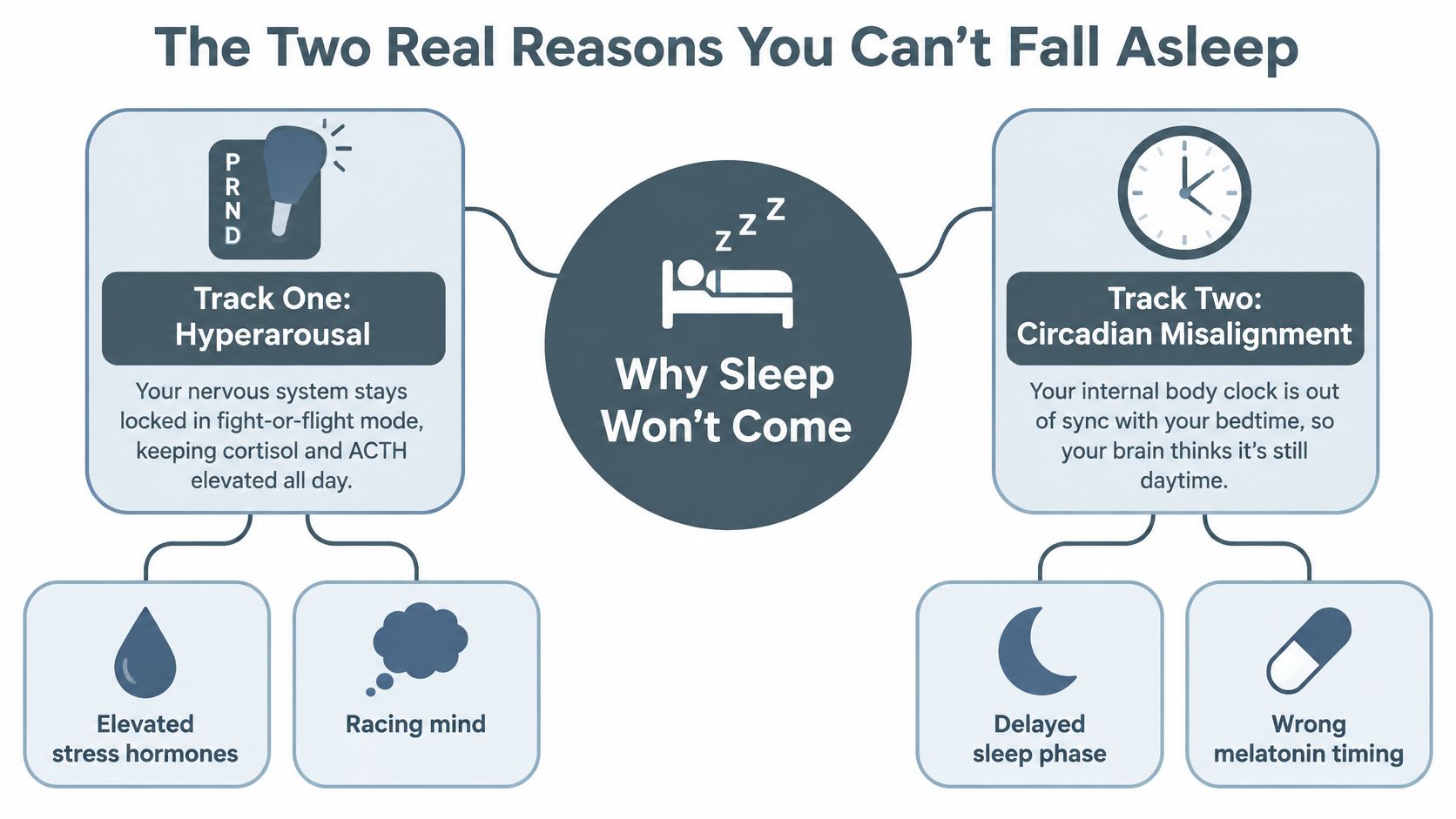
These tracks can overlap. A late body clock can make bedtime frustrating, and repeated frustration can train your nervous system to treat bed as a place to stay alert. That's why a single-cause explanation, such as “it's just stress” or “it's just your phone,” often falls short.
Difficulty falling asleep is common, but an occasional restless night isn't automatically an insomnia disorder. The American Academy of Sleep Medicine describes insomnia as difficulty initiating or maintaining sleep, or getting restorative sleep, despite adequate opportunity and circumstances, alongside daytime effects such as fatigue, irritability, low mood, or cognitive problems. Its clinical criteria need to be considered with persistence and daytime impact, not used as a self-diagnosis. You can read a practical overview of what causes insomnia and how to fix for more context.
The complaint itself is widespread: 15.4% of U.S. adults, roughly one in six, reported trouble falling asleep most days or every day, according to the 2024 National Health Interview Survey. The figure was 18.3% among adults aged 18–34, compared with 12.8% among adults aged 65 and older. The useful question isn't whether you've ever had a bad night. It's which pattern keeps recurring, and what happens to your functioning during the day.
When Your Body Is Wired But Your Eyes Are Heavy
Hyperarousal is a stuck gearshift. Your body may feel worn down, but the system that helps you respond to demands hasn't shifted into a restful state. You lie down and suddenly replay a conversation, plan tomorrow, or monitor every minute you're still awake. Heavy eyes and a busy, alert mind can coexist.
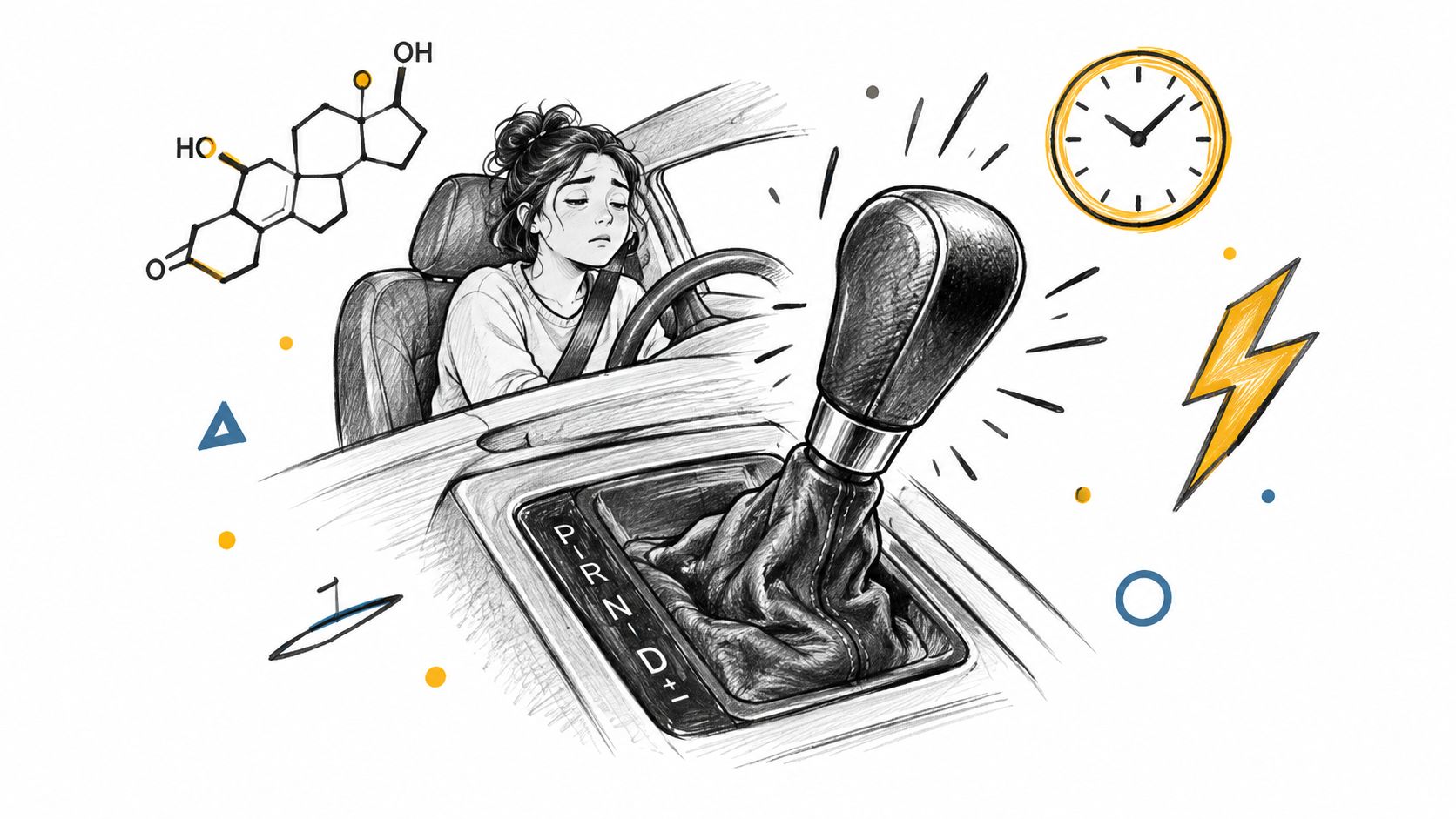
This isn't just a metaphor for worrying. NIH Endotext summarizes controlled studies in which people with chronic insomnia had higher 24-hour ACTH and cortisol concentrations than matched good sleepers. The elevations retained a normal circadian pattern and correlated positively with objective sleep disturbance, according to the Endotext review of sleep and stress physiology. In plain English, stress-system activation can remain high across the day and night. Feeling exhausted doesn't necessarily mean the body has stopped acting alert.
Stop teaching your bed to mean “try harder”
If you're awake and becoming frustrated, don't stay in bed rehearsing the same effort. Get up, keep the light low, and do something quiet until you feel sleepy. Then return to bed. This is stimulus control, a behavioral technique intended to rebuild the bed's association with sleep rather than wakeful struggle.
The point isn't to punish yourself or follow a rigid timer. It's to notice when lying there is making you more alert and change the setting before frustration takes over. Avoid checking the clock repeatedly; calculating how much sleep you're losing gives your brain another problem to solve.
Practical rule: Go to bed when you're sleepy, not simply because you feel depleted or think you ought to be asleep by then.
If racing thoughts are the main obstacle, write down what you're worried about and what you'll handle tomorrow, then close the notebook. A focused guide to calming racing thoughts at night can help you choose a technique that suits the pattern. But don't assume every wired night is a relaxation problem. If your body clock is late, the next move is about timing.
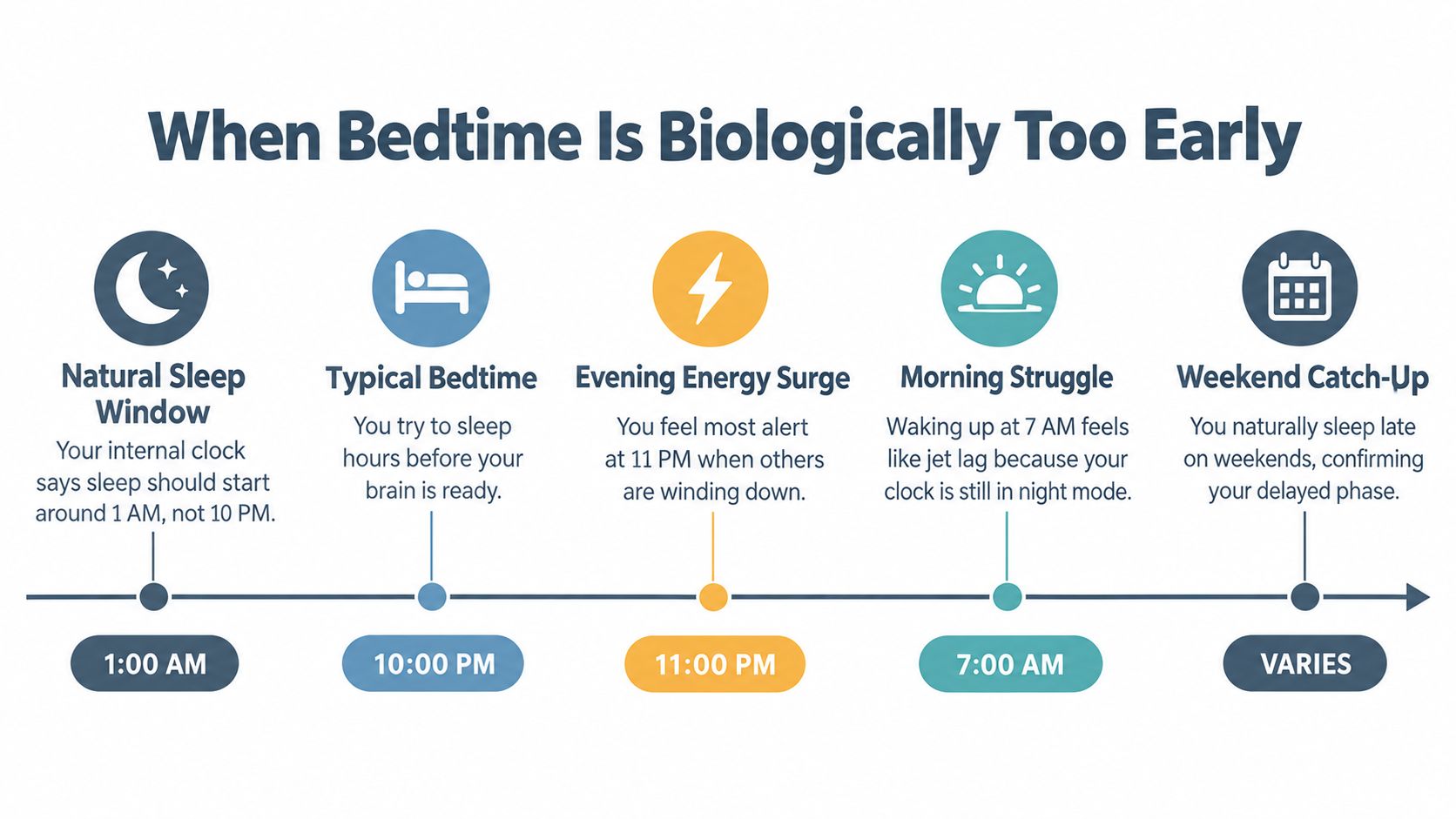
When Bedtime Is Biologically Too Early
Your internal clock works more like a schedule than a light switch. It helps coordinate when you feel alert and when your body is prepared for sleep. If that schedule runs late, a conventional bedtime can arrive while your brain still behaves as though it's daytime.
A delayed body clock is more likely when you fall asleep much later than intended, sleep relatively normally if you're allowed to keep that later schedule, and struggle to wake for morning commitments. Catch-up sleep on free days can be another clue. Those patterns point toward timing as something to investigate, rather than treating every late night as proof you need to get into bed earlier.
Earlier isn't always better
Here's the counterintuitive part: going to bed earlier can make the struggle worse. A clinical review found that adults with sleep-onset insomnia had melatonin onset more than one hour later on average than good sleepers, yet tried to fall asleep at roughly the same clock time. They were trying during the circadian “forbidden zone,” when falling asleep is naturally harder, as described in this review of circadian timing and sleep-onset insomnia.
If you recognize this pattern, anchor your wake time first and keep it consistent. Get appropriately timed morning light to support an earlier circadian schedule, and reduce bright light and screens in the evening. These steps target clock timing, not just relaxation. Avoid abruptly forcing an unusually early bedtime and then treating the resulting wakefulness as a personal failure.
Sleep diaries can help reveal whether your sleep window shifts on days without morning obligations. A clinician may use tools such as sleep diaries, actigraphy, chronotype assessment, or melatonin timing to evaluate a persistent pattern. For information about professional evaluation, see circadian rhythm disorder telehealth care. A circadian rhythm reset guide can also help you think through schedule and light cues. Don't treat melatonin as a universal knockout pill: circadian interventions are timing-sensitive, and the right approach depends on the pattern.
The Behavioral Audit That Often Gets Skipped
Before rebuilding your whole lifestyle, look for a specific behavior that could be delaying sleep. Don't make five changes at once. Keep a brief record of bedtime, estimated time to fall asleep, wake time, naps, caffeine, alcohol, evening screen use, and anything in your room that disrupts comfort. Track it for one to two weeks, then change the most plausible lever.
Caffeine deserves a closer look than “I don't drink coffee at bedtime.” An evidence review reports that its half-life commonly ranges from about 3 to 7 hours, and associates 101–400 mg consumed within eight hours of bedtime with shorter sleep. For example, someone who takes in 200 mg and has a five-hour half-life could still have roughly 100 mg in their system after five hours, based on the review of caffeine and sleep. Individual metabolism varies, so log the timing and amount rather than guessing.
Alcohol may make you feel drowsy at first, but it isn't a reliable sleep-onset treatment and can disrupt the night. Screens can keep you mentally engaged and expose you to bright light. Long or late naps may take away some of the sleep pressure you need at night. Noise, light, temperature, and an uncomfortable sleep setup can also keep you alert.
| Factor | Why it delays sleep onset | First lever to pull | Trial window |
|---|---|---|---|
| Caffeine | Stimulant effects can persist into the evening | Record dose and timing; move the last serving earlier | One to two weeks |
| Alcohol | Drowsiness doesn't guarantee settled sleep | Compare nights with and without an evening drink | One to two weeks |
| Screens and bright light | Light and engaging content can maintain alertness | Dim lights and stop stimulating browsing before bed | One to two weeks |
| Long or late naps | May reduce nighttime sleep pressure | Shorten or move naps earlier, then observe | One to two weeks |
| Bedroom disruption | Light, noise, or discomfort can keep you awake | Change the specific disturbance you notice | One to two weeks |
Use this as a ranking tool, not a verdict. If you drink coffee late and nap after work, test the factor that best matches your log instead of adopting an exhausting set of rules. For a focused look at whether coffee keeps you awake, consider both the amount and the clock time you drink it.
Could Something Else Be Driving This
Before you add another routine or supplement, check whether a hidden symptom needs medical attention. A sleep habit can't resolve a breathing disorder, medication effect, chronic pain, or untreated mood problem.
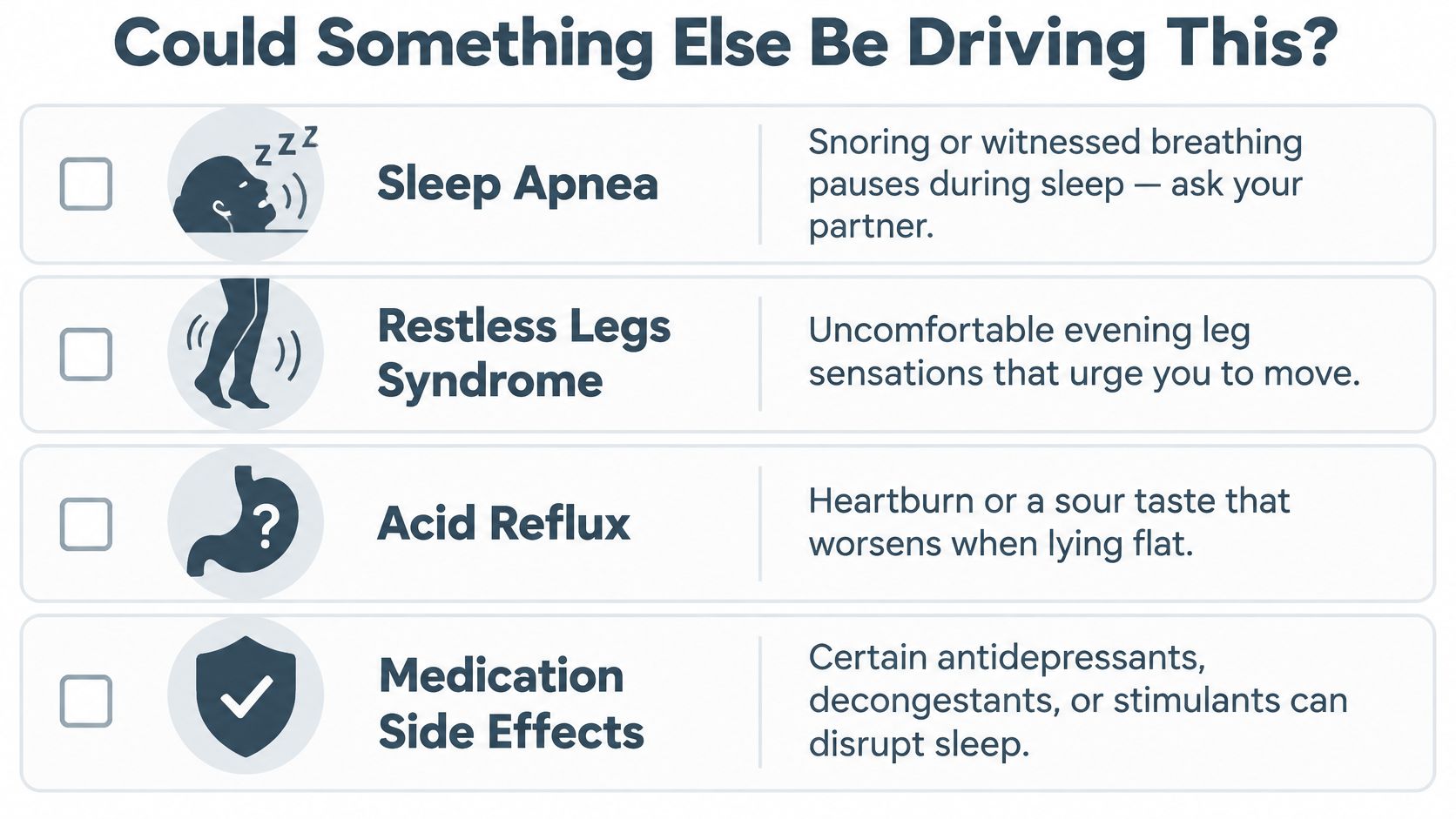
Use these questions as a triage screen, not a way to diagnose yourself:
- Breathing: Does a partner report loud snoring, gasping, or pauses in your breathing? Ask someone who can observe your sleep. Don't try to solve suspected breathing pauses with a bedtime routine.
- Leg sensations: Do uncomfortable sensations in your legs show up in the evening and urge you to move? Mention the timing and what relieves them to a clinician.
- Mood: Are anxiety, low mood, nightmares, or persistent distress part of the picture? The American Medical Association identifies restless legs syndrome, sleep apnea, nightmares, anxiety, and depression as contributors to insomnia; depression is associated with a roughly two- to three-times greater likelihood of insomnia symptoms, according to the clinical review. If mood symptoms are affecting sleep and daily life, Life Primary Care anxiety support may be a useful starting point for finding support.
- Medication, alcohol, or pain: Did the problem begin or change around a new medication, more alcohol, or worsening pain? Bring that timeline to your clinician instead of stopping prescribed medication on your own.
Seek professional assessment if sleep difficulty keeps recurring despite adequate time and opportunity for sleep, meaningfully affects your day, or comes with snoring, witnessed breathing pauses, uncomfortable leg sensations, or significant mood symptoms. Persistent trouble deserves an evaluation, not a cycle of increasingly elaborate self-experiments.
Evidence-Based Tools That Actually Shift Sleep Onset
The strongest tools depend on the mechanism you're trying to change. The American Academy of Sleep Medicine's evidence review found moderate overall benefit for multicomponent CBT-I, while sleep-hygiene education alone isn't supported as an adequate standalone treatment for chronic insomnia. That distinction matters: a list of sensible habits isn't the same as treatment designed to change the bed-wakefulness association or consolidate sleep.
Stimulus control targets the association. Go to bed when sleepy, use the bed for sleep, and get out of it when wakefulness becomes frustrating. Return when sleepiness comes back. Keep the activity quiet and the lighting low.
Sleep restriction therapy targets the gap between time in bed and actual sleep. It limits time in bed toward actual sleep duration to consolidate sleep pressure. It shouldn't mean arbitrarily depriving yourself of sleep; talk with a clinician about whether it fits your situation, especially if you have other health concerns.
A wind-down cue targets arousal. Choose one repeatable activity, such as journaling, a quiet book, or slow breathing, and use it to mark the shift out of work and planning mode. If you try a routine, keep it simple enough to repeat. Don't interpret one difficult night as evidence that the technique has failed.
Treat products as optional supports, not diagnosis or treatment
Melatonin is better understood as a timing cue than as a guaranteed sedative, and timing matters when the issue is a delayed body clock. A melatonin-free product isn't automatically the right answer either. If you're considering Restore+ Sleep Aid, its product information describes it as melatonin-free and formulated to support nitric oxide production and overnight recovery. That's a product description, not evidence that it treats chronic insomnia or replaces assessment.
Choose the tool that matches your likely track. If bed has become a place where you struggle, start with stimulus control. If your schedule suggests a delayed clock, focus on consistent wake timing and light cues. If a symptom points to another disorder, prioritize evaluation over another product.
A Melatonin-Free Wind-Down Routine You Can Run Tonight
A routine only works if it matches the reason you're awake. If your nervous system is still running at daytime speed, the job is to lower arousal. If your clock is set later than your bedtime, no ritual will produce sleepiness that isn't there yet. Decide which problem you're treating before you build anything.
For the wired version, make the last hour feel physically different from the rest of your evening. Dim the lights. Park the stimulating screens. Write down the thoughts you keep trying to solve in bed, and put tomorrow's tasks on paper so you stop rehearsing them under the covers. Then pick one quiet activity you can repeat nightly, like slow breathing or a few pages of an unremarkable book.
If a warm drink is part of what helps you slow down, keep it as a cue rather than expecting it to knock you out. A melatonin-free formula can fit that cue, but a drink or supplement can't shift a delayed body clock by itself. If your problem is timing, the fix lives in your schedule and light exposure, not in a mug.
Make breathing support a separate decision
Nasal strips are designed to gently open the nasal passages and support smoother airflow during sleep. They may be relevant if nasal airflow is part of your concern, but they aren't a substitute for checking persistent snoring or breathing pauses. If you're considering Mouth Tape, the product is described as gently encouraging nasal breathing by keeping the lips comfortably sealed. Don't use mouth tape to try to address suspected sleep apnea or if you can't breathe comfortably through your nose; get medical advice about breathing concerns first.
Keep the sequence calm and repeatable: dim the room, set aside worries, and choose a low-stimulation activity. Add a breathing aid only if it fits your needs and feels comfortable. Products are optional supports, not the central treatment for ongoing insomnia.
If you change only one thing tonight: stop trying to force sleep in bed. Get up when frustration is building, keep the light low, and return when you feel sleepy.
The aim is a gentle transition, not a perfect bedtime ritual. If a routine makes you watch the clock, worry about doing it correctly, or adds more pressure, cut it back to one or two steps.
What to Try First and When to Get Help
For the next two weeks, choose the most likely lever from your audit, keep a steady wake time, and use stimulus control when you're awake and frustrated. Add just one wind-down cue and record whether sleep onset changes. Look for a developing pattern, not a miraculous overnight result.
Contact a clinician if trouble persists, substantially affects your day, or comes with snoring, witnessed breathing pauses, restless legs, pain, medication concerns, or mood symptoms. Improvement may begin as less time spent fighting sleep or clearer patterns in your diary. If symptoms continue, don't keep adding routines. Get help identifying the cause.
SleepHabits offers melatonin-free sleep support and breathing products, including nasal strips and mouth tape, alongside practical sleep education. If you're exploring optional supports for your wind-down routine, visit SleepHabits and choose only what fits your needs.