

You're in bed, lights off, and your mind won't quiet down. A conversation from work replays, tomorrow's list grows longer, and checking the clock only makes you more alert. That's the moment many people search for 4-7-8 breathing for sleep. It can help you feel calmer, but calm and proven sleep improvement aren't the same thing. Try it as a wind-down skill, track what happens, and don't expect an instant off switch.
How to Do 4-7-8 Breathing Step by Step
Start where you'll use it, sitting on the edge of the bed or lying down. Let your shoulders drop, unclench your jaw, and keep your hands loose. You're not trying to take the biggest breath possible. You're setting a slow rhythm your body can follow without effort.
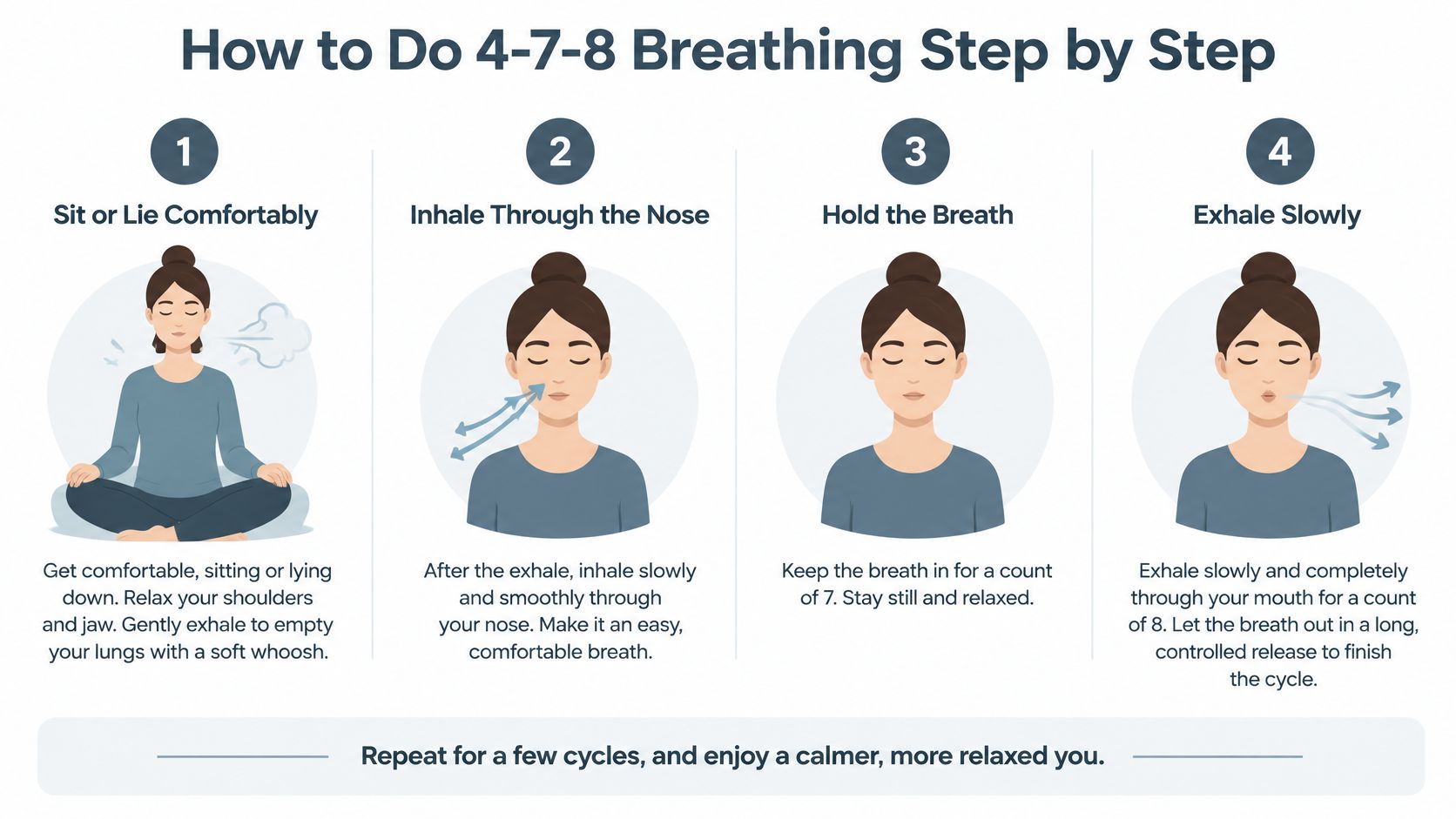
The Four Steps in One Cycle
- Empty your lungs first. Exhale fully through your mouth with a soft whoosh. Starting empty gives the next inhale an easy volume, so you don't gasp or stack breath on top of breath.
- Inhale through your nose for 4. Close your lips and keep the breath smooth and controlled. Nasal inhalation naturally slows the air down and helps you avoid a loud, rushed gulp.
- Hold for 7. Keep the tip of your tongue resting against the tissue just behind your upper front teeth, and keep your shoulders still. The hold is a pause, not a brace. If your neck tightens, you're working too hard.
- Exhale through your mouth for 8. Let your lips stay slightly pursed around your tongue and release the air with a soft whoosh. This long exhale is the calming part of the pattern, so don't dump it out in the first two counts.
That's one cycle. The Cleveland Clinic guide to 4-7-8 breathing describes inhaling through the nose without making a sound for 4 counts, holding for 7 counts, and exhaling slowly through the mouth for 8 counts, for 19 counts in total. It also advises a pace that feels comfortable rather than forcing the counts, while retaining the 4:7:8 relationship.
What a Good Cycle Feels Like
Repeat the cycle, then return to normal breathing and stop counting. By the fourth round, the exhale should feel slower and heavier, and your shoulders and jaw should feel less set. You might yawn or notice your hands feel warmer. You might feel less wired.
Practical rule: Quiet in, still hold, slow out. If any phase feels like a performance, make the whole count faster and smaller.
Watch for three common slips.
- A loud gasp on the inhale: Take less air and let the nose set the pace.
- Shoulders lifting during the hold: Drop them before you start counting to 7.
- A rushed exhale: Purse your lips slightly so the air has to leave slowly.
Don't judge the first attempt. Counting, tongue position, and mouth shape can feel clumsy at first. Practice once during the day when you're not desperate for sleep, so the sequence feels familiar at night. No instant sleep is promised, and that's fine. A good first goal is finishing four cycles feeling calmer than when you started.
Choose a Routine and Count for Your Level
It is late, the room is already cool, and the hold still feels like a test you might fail. Start on the beginner row. Four cycles teach the rhythm without turning bedtime into a breath-holding contest. Move up only when the counts feel calm, the exhale stays controlled, and nothing strains.
| Routine | Ratio (inhale:hold:exhale) | Cycles | When to use it |
|---|---|---|---|
| Beginner start | 4:7:8 | 4 cycles | First week, or after a stressful day |
| Standard bedtime | 4:7:8 | About 6 cycles | Once the counts feel comfortable |
| Faster count | 2:3.5:4 | 4 cycles | When full counts cause strain |
| Nightly trial | 4:7:8 | 4 cycles each night for 7-14 nights | Tracking sleep before judging the result |
The Sleep Foundation guide to breathing exercises for sleep describes emptying the lungs, inhaling through the nose for 4, holding for 7, exhaling through the mouth for 8, and repeating the pattern approximately six times before returning to normal breathing. Four is the learning dose. About six is a comfort checkpoint, not a promise that you will fall asleep faster. The longer exhale can settle a wired evening. Whether the night itself changes is something you watch over your own week.
How to Pick Your Row Tonight
If you are new, tense, or already dreading the hold, use four cycles at a comfortable speed. Lie down or sit, drop your shoulders, empty the lungs, run those cycles, then stop counting and breathe as you normally would.
Full counts can feel like holding a long note before you know the song. Keep the same shape and shrink the clock. A 2:3.5:4 version does that, though whole numbers are easier, so you can also count the familiar 4, 7, and 8 a little faster. The WebMD overview of breathing techniques for sleep describes beginning with only four consecutive cycles and practicing at least twice daily, rather than opening with a long session.
One clash most bedtime guides skip: the classic pattern sends that long exhale out through the mouth. Mouth tape sits centered over closed lips so breathing stays in the nose. Run the counted cycles before the tape goes on. Once it is in place, switch to slow nasal breaths and save the mouth exhale for untaped practice.
Use the nightly trial row as your own check. Four cycles each night for 7 to 14 nights, with the same wind-down, then compare how wired you felt at lights-out with how the night went. On a difficult night, set the counting aside and compare this pattern with box breathing for sleep. Choose the one you can finish without tension.
Restore+ is designed to work best as part of a nightly ritual with a cool room, nasal breathing, limited screens, and consistent sleep and wake times. Stay on the beginner row for the first week. Shift to the standard bedtime row only after several calm, strain-free nights.
Why Slow Breathing Can Calm the Body at Night
When you're wound up, breathing tends to get faster and shallower. Deliberately slowing it, especially by making the exhale longer than the inhale, gives your body's rest-and-recover branch a clearer signal. Heart rate can ease, muscles stop bracing, and the sense of urgency often drops.
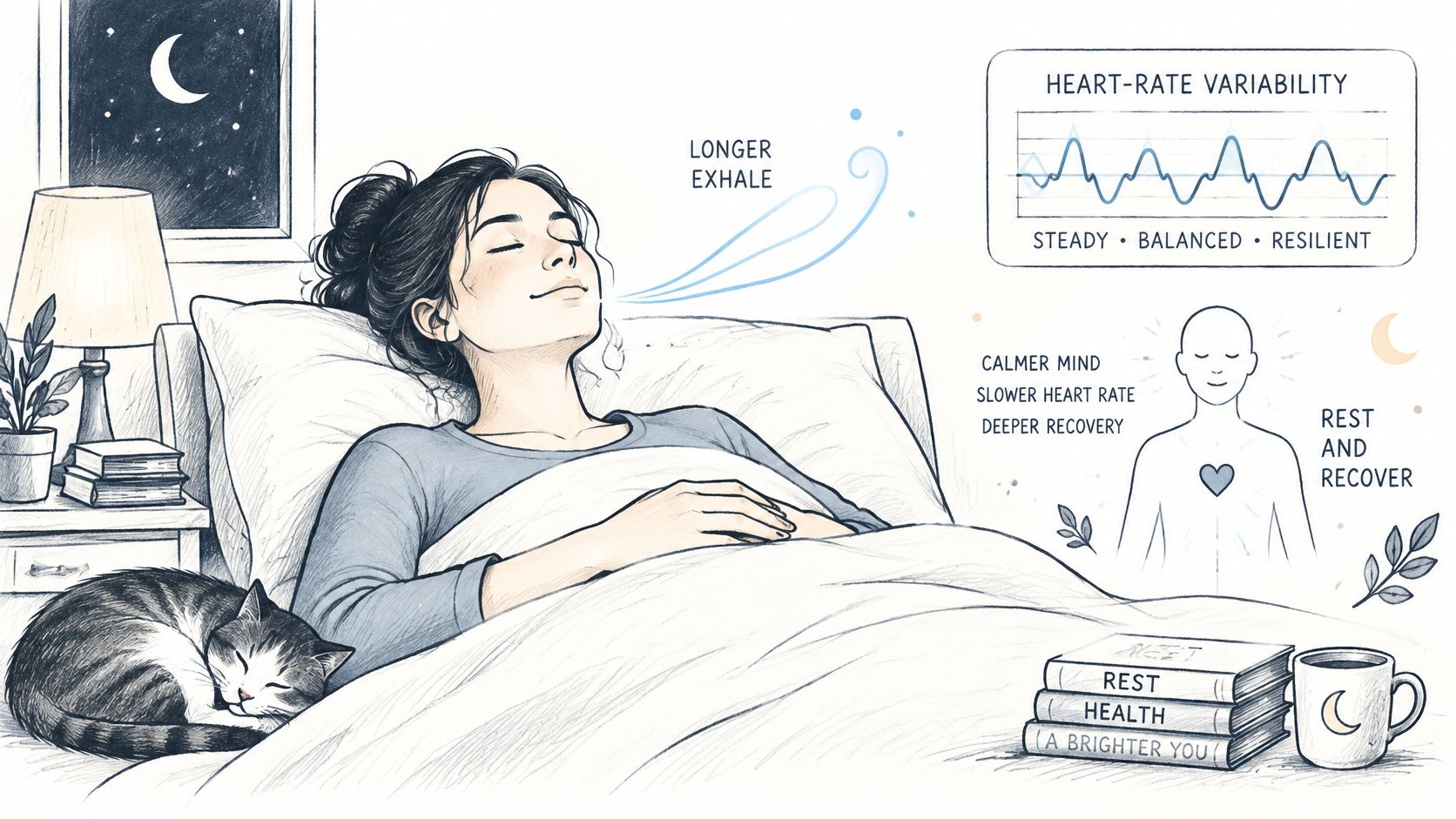
Researchers often watch heart-rate variability, the small variation in time between heartbeats. It isn't a sleep score. It's a window into how flexibly your nervous system is regulating itself in the moment.
In the laboratory study published in Physiological Reports, 43 healthy adults aged 19 to 25 were tested immediately after baseline measurements. Among controls, high-frequency heart-rate-variability power increased while low- and very-low-frequency power decreased, findings consistent with an acute shift toward parasympathetic regulation. The protocol produces an approximately 19-second respiratory cycle, or about 3.2 breaths per minute during the active sets.
That wording matters. An acute shift in a lab means your body can become calmer for a short period. It doesn't prove you'll fall asleep faster tonight, stay asleep longer, or resolve insomnia. Keep those claims separate and the technique becomes easier to judge fairly.
The Attention Effect
Counting also gives a racing mind a job. Instead of rehearsing an email, you track 4, then 7, then 8. The thought may return, but you've interrupted the loop for a few breaths.
Say a parent gets home from a long shift, showers, and lies down still replaying the day. Four slow cycles won't erase exhaustion or stress. They can create a clear boundary between the shift and bed, and that boundary is often the useful part. If you want the slower rhythm without a long hold, the principles in how to breathe slowly can help you build a gentler version.
The guided practice below is useful during the day, when you can learn the timing without pressure to fall asleep.
What the Evidence Can and Cannot Confirm
You can feel calmer after a few slow cycles and still lie awake. Calm is what this pattern is built to support. Faster sleep onset and fewer wake-ups are a separate claim, and the trials have not settled it. 4-7-8 breathing is a low-cost relaxation adjunct, not an established insomnia treatment. No large trial has isolated this exact pattern and shown that it reliably improves sleep onset.
| Evidence | Population | Finding | Limit |
|---|---|---|---|
| Expert clinical review | Adults in pre/post reports | Before-and-after notes describe easier mood and easier nights | Limited evidence and no large 4-7-8 trials |
| 2025 university study | University participants | Self-rated sleep looked better after a short practice period | Authors call for larger, randomized, longer studies |
| Hemodialysis trial | People receiving hemodialysis | Sleep looked better when several breathing exercises were used together | Not transferable to healthy adults |
| Randomized paced-breathing trial | Adults with sleep disturbance | No clear sleep difference between a slower pace and a more ordinary pace | Not a 4-7-8 study and uses equal inhale and exhale |
Read the table the way you would read a weather report for another city. Who was studied, and was the intervention 4-7-8? A combined program in people receiving hemodialysis cannot tell a healthy adult with ordinary restlessness what will happen at home. A paced-breathing trial with equal inhale and exhale timing also cannot settle the value of a long exhale plus a hold.
The 2025 review indexed in PubMed Central describes promising improvements in adult sleep but notes that protocols vary substantially and that standardized, evidence-based schedules are still needed. It also highlights the lack of evidence isolating the exact 4-second inhale, 7-second breath hold, and 8-second exhale from slower breathing more generally.
The Question Your Log Can Answer
Does the precise count beat breathing slowly with a longer exhale? Current evidence doesn't answer that well. Samples are often small and specialized, with limited coverage of chronic insomnia, shift-work sleep disruption, or ordinary nighttime restlessness.
One clash most viral guides skip: usual teaching sends the long exhale out through the mouth. Mouth tape is meant to keep the lips gently closed so breathing stays nasal. If the tape is on, use the 8-count as a slow exhale through the nose. Forcing air against sealed lips fights the setup that supports nighttime nasal breathing.
A percentage copied from a viral post is not your result. Measure your own time to sleep, awakenings, and next-day alertness.
The practice can still earn a place as a way to settle. Treat any sleep benefit as a personal result to test over your own nights. If poor sleep persists, breathing exercises should not replace evaluation or established insomnia care.
When to Skip or Adjust the Breathing Pattern
Dizziness is the most common warning sign that the pattern is too demanding. Make one change tonight. Shorten the hold, take smaller breaths, or stop and breathe normally until the feeling passes. Don't push through to finish a set.
| Symptom | Likely cause | What to do |
|---|---|---|
| Dizziness or light-headedness | Hold too long or inhale too forcefully | Shorten the hold or stop and breathe normally |
| Air hunger | Breaths too large or counts too demanding | Use a gentler pace and smaller breaths |
| Anxiety or panic during the hold | The hold feels threatening | Drop the hold and keep a slow exhale |
| Wheezing or chest discomfort | Possible respiratory or heart condition | Stop and get clinician guidance |
| Palpitations | Strain during breath holding or an underlying condition | Stop and seek medical advice |
The counts are a template, not a performance target. Breathe gently, avoid a forceful inhalation, and shorten or remove the hold if it feels uncomfortable. A slow exhale without a hold is a sensible fallback and keeps the part many find calming.
The PubMed record for the 2025 randomized trial concerns several breathing exercises, including 4-7-8 breathing, among people receiving hemodialysis. That result cannot be generalized automatically to healthy adults, people with respiratory disease, or those prone to panic and dizziness. Your own symptoms are more relevant to tonight's decision than a finding from a different population.
When to Get Medical Advice First
Check with a clinician before practicing prolonged holds if you have a respiratory or cardiovascular condition. Do the same if you can't breathe comfortably through your nose, take prescription sleep medication, are pregnant or nursing, or have chronic insomnia lasting longer than three months.
Adults with sleep apnea or suspected sleep apnea, prescription sleep medication users, people with cardiovascular conditions or blood-pressure concerns, pregnant or nursing people, people managing a medical condition, and people with chronic insomnia lasting longer than 3 months should consult a physician or sleep specialist before using Restore+.
Seek prompt medical review for unexplained nighttime breathlessness, loud snoring with witnessed pauses, or suspected sleep apnea. Relaxation breathing doesn't diagnose or treat an underlying breathing disorder, and comfortable breathing always comes before completing the count.
Fitting 4-7-8 Into Your Wind-Down Routine
Order matters because 4-7-8 uses a mouth exhale. Run your cycles before applying mouth tape, then settle into nasal breathing for the night. Trying to whoosh through taped lips turns a calming exercise into a frustrating one.
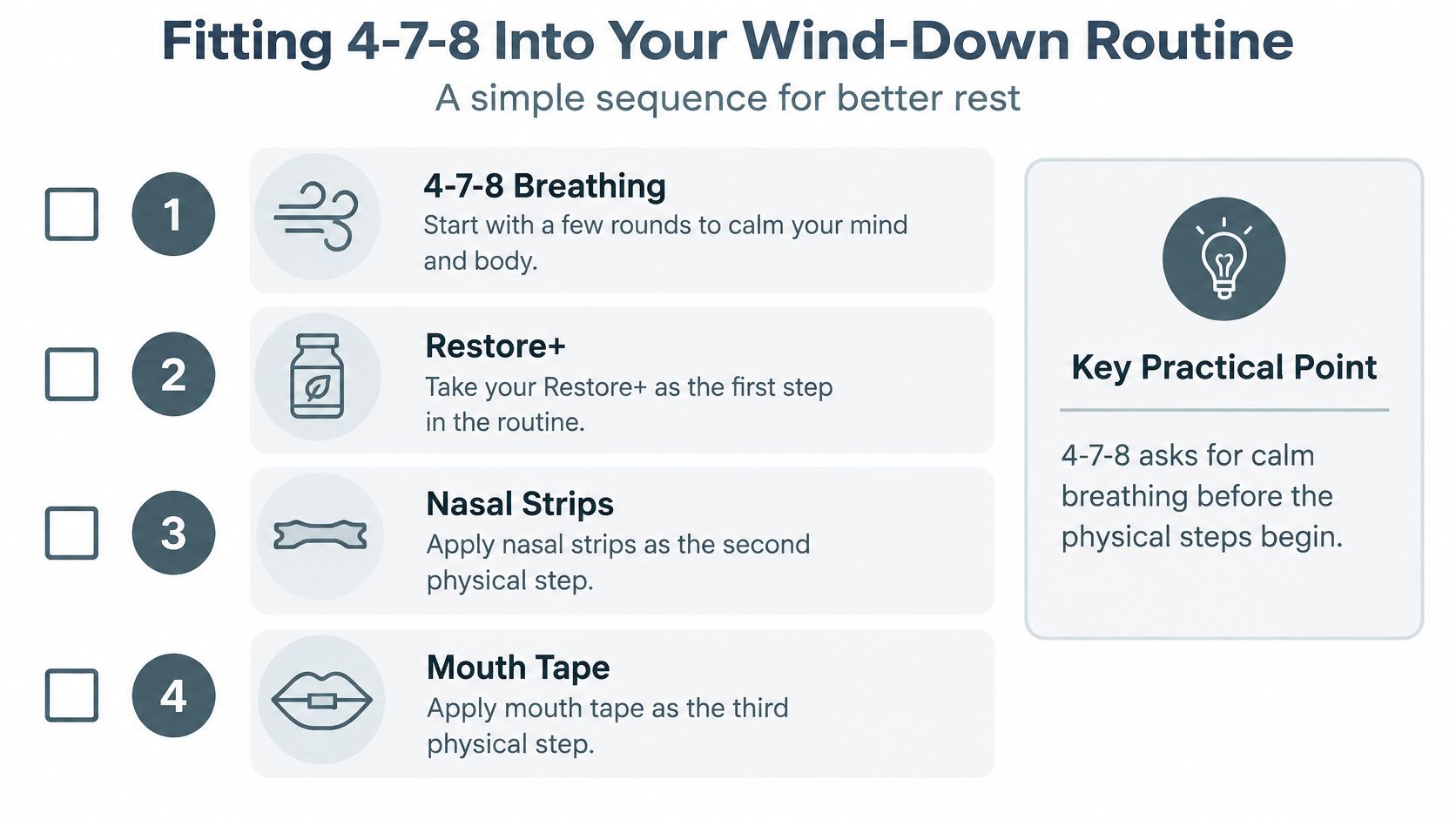
Our routine has 3 steps, Restore+, then Nasal Strips, then Mouth Tape. Place your breathing practice before the physical steps. A workable checklist looks like this.
- Dim the room: Put screens away and set the bedroom cool.
- Take Restore+ if you use it: Keep the timing consistent each night.
- Run four 4-7-8 cycles: Sit on the bed, finish the final mouth exhale, then breathe normally.
- Apply strips and tape if you use them: Get comfortable first so you aren't adjusting things in the dark.
- Lie down at a consistent time: Let regular sleep and wake times anchor the ritual.
The tape is placed centered over closed lips, breathing is done slowly through the nose, and it is removed easily in the morning. For broader ideas on sequencing your evening, see bedtime routine tips from Lila and our guide to wind-down activities before bed.
Say you sit on the bed while the room cools, run four cycles, then apply your strips and tape once. You've removed the nightly fiddling and given each step a clear place. The ritual matters more than any single step, and the two-week trial below lets you test the full sequence fairly.
Start a Two-Week Trial Tonight
Don't judge 4-7-8 breathing for sleep from one restless night. Give it a baseline, a fixed routine, and a simple log. That's how you separate a real change from a hopeful impression.
First, record a baseline week. Note your approximate time to fall asleep, number of awakenings, and next-day alertness. Then practice four cycles once nightly at the same time for 7 to 14 nights and record the same three things.
The CNN expert review of 4-7-8 breathing notes the lack of a validated 4-7-8 sleep-success rate and emphasizes that large 4-7-8-specific randomized trials are lacking. So don't claim a percentage improvement unless you measured it in your own log.
Your Nightly Log
Use five columns and keep entries brief.
- Date
- Minutes to fall asleep
- Awakenings
- Next-day alertness, 1 to 5
- Breathing discomfort, yes or no
Keep the routine if sleep onset or awakenings improve and the practice feels calm. Switch to a gentler slow-exhale pattern if discomfort appears. Stop and seek advice if breath holding causes panic, chest discomfort, wheezing, faintness, or palpitations.
For some people, results with Restore+ may take 1 to 2 weeks as the nervous system stabilizes, breathing improves, and the sleep routine becomes more consistent. If sleep problems persist beyond your trial, or insomnia has lasted more than three months, book a visit with a physician or sleep specialist. Start tonight with four comfortable cycles and write down what happens.
Build your trial around a calmer, nose-first night with SleepHabits, from Restore+ to nasal strips and mouth tape that support consistent nasal breathing after your final 4-7-8 exhale. Explore the routine and choose the tools that fit your log at SleepHabits, then keep the same order for two weeks so you can judge the results clearly.