

Nasal strips can help snoring when congestion or narrow nasal passages are the cause, but they won't fix throat-based obstruction or sleep apnea. In obstructive sleep apnea trials, the mean change in the apnea-hypopnea index was just 0.36 events per hour, a result that wasn't statistically significant.
That distinction challenges the most popular advice about this remedy. A strip can make your nose feel more open, yet easier nasal breathing doesn't prove that your airway is safe or that your sleep will become more restorative. The useful question isn't, “Do nasal strips help snoring?” It's, “Where is the airflow problem happening?”
Nasal vs. Throat Snoring: Understanding the Difference
If snoring worsens during a cold but fades when congestion clears, the nose is likely involved. If it continues while your nose feels open, the narrowing may be farther down the airway.
Snoring begins when air passes through a narrowed space and makes relaxed tissues vibrate. Those tissues can include the soft palate, tongue, and throat structures. Nasal congestion can make breathing harder and encourage mouth breathing, yet the nose may only be the first restricted point rather than the main source of the sound.
An airway with several narrow points behaves like a route with more than one bottleneck. Clearing the entrance can improve traffic at that point, while a separate blockage farther along remains. A nasal strip may therefore help someone who snores during a cold and do little for someone whose tongue or throat narrows during sleep.
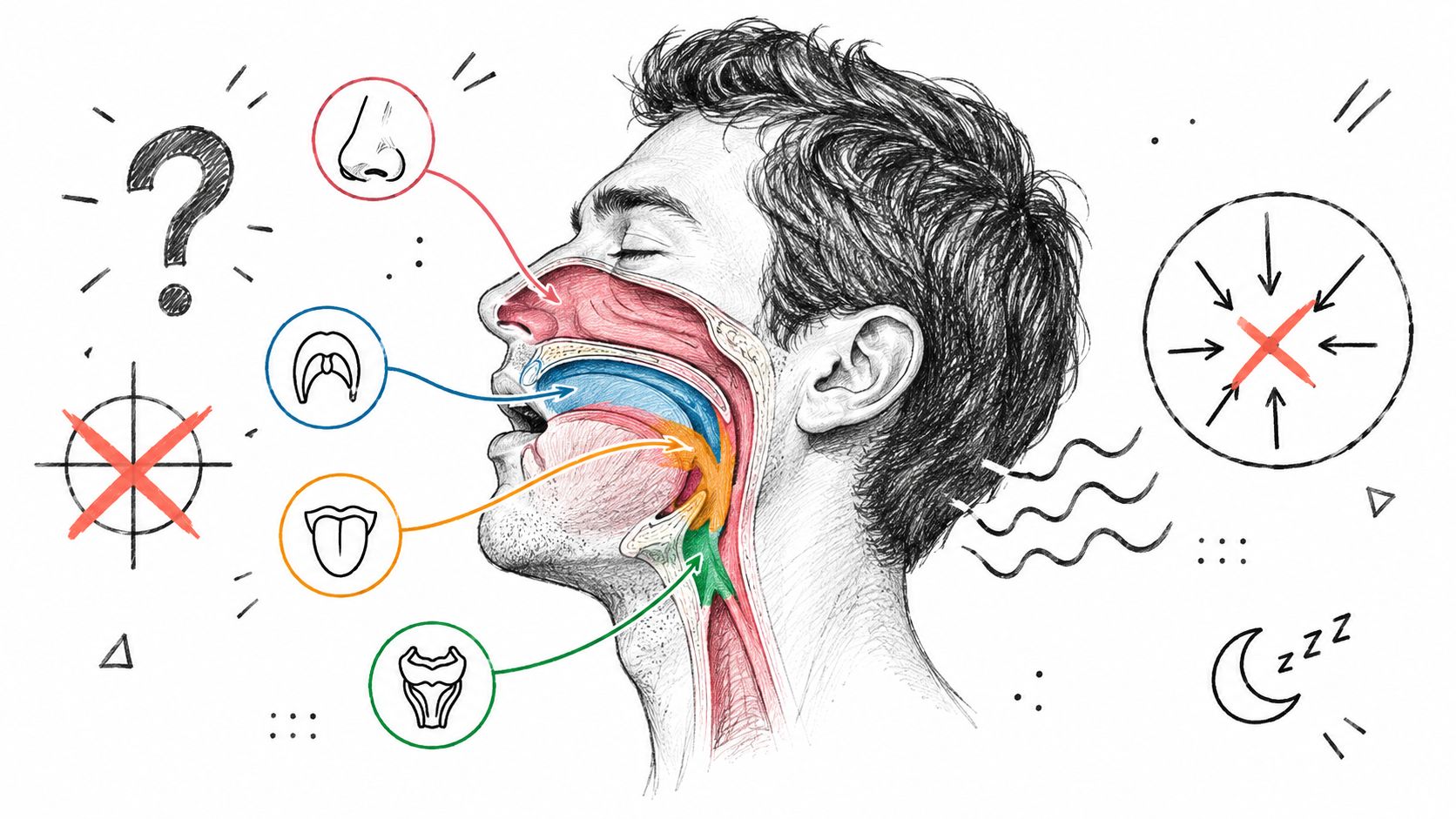
Nasal snoring and throat snoring aren't interchangeable
Nasal strips mechanically widen the nasal passage. They may help when snoring is linked to nasal congestion, rhinitis, or narrowing at the nasal valve, the narrow area where air enters the nose. Their effect ends at the nose. The tongue, soft palate, and surrounding tissues in the throat or oral-pharyngeal airway can still vibrate or collapse.
A guide to what causes snoring at night can help you assess possible triggers, including a blocked nose, sleep position, and mouth breathing. Home observations can suggest a pattern, but they cannot confirm whether repeated breathing interruptions occur.
Practical rule: A quieter nose isn't the same as an open airway from the nose to the lungs.
The distinction matters when snoring occurs with witnessed breathing pauses, gasping, loud habitual noise, or pronounced daytime sleepiness. Evidence reviews found no meaningful improvement in the apnea-hypopnea index, oxygen saturation, or snoring measures among people with obstructive sleep apnea who used nasal dilators, according to the British Columbia sleep apnea guideline. Nasal strips should not serve as the only treatment when OSA is suspected.
For example, a strip has a plausible target when seasonal congestion blocks one side of the nose and snoring improves after the nose clears. Choking sounds or observed pauses, even with clear nasal breathing, point toward a problem that needs medical evaluation.
How Nasal Strips Work to Improve Airflow
A nasal strip is a small adhesive device with flexible ribs that pull the nasal sidewalls outward when applied to the outside of the nose. This mechanical action widens the nasal passage and reduces airflow resistance at the nostril level. It can make nasal breathing easier, but it cannot open the throat.
The distinction matters because snoring has more than one possible source. A strip targets narrowing near the front of the nose, much like widening one lane at the entrance to a road. If the nose is the bottleneck, airflow may become smoother. If the sound comes from vibration or collapse in the soft palate, tongue, or throat, widening the nose may not change it.
Nasal strips can also reduce the need to breathe through the mouth when congestion or a narrow-feeling nasal passage makes nasal breathing difficult. Their effect is mechanical rather than medicinal. They do not reduce throat inflammation, reposition the tongue, or hold the soft palate away from the back of the throat.
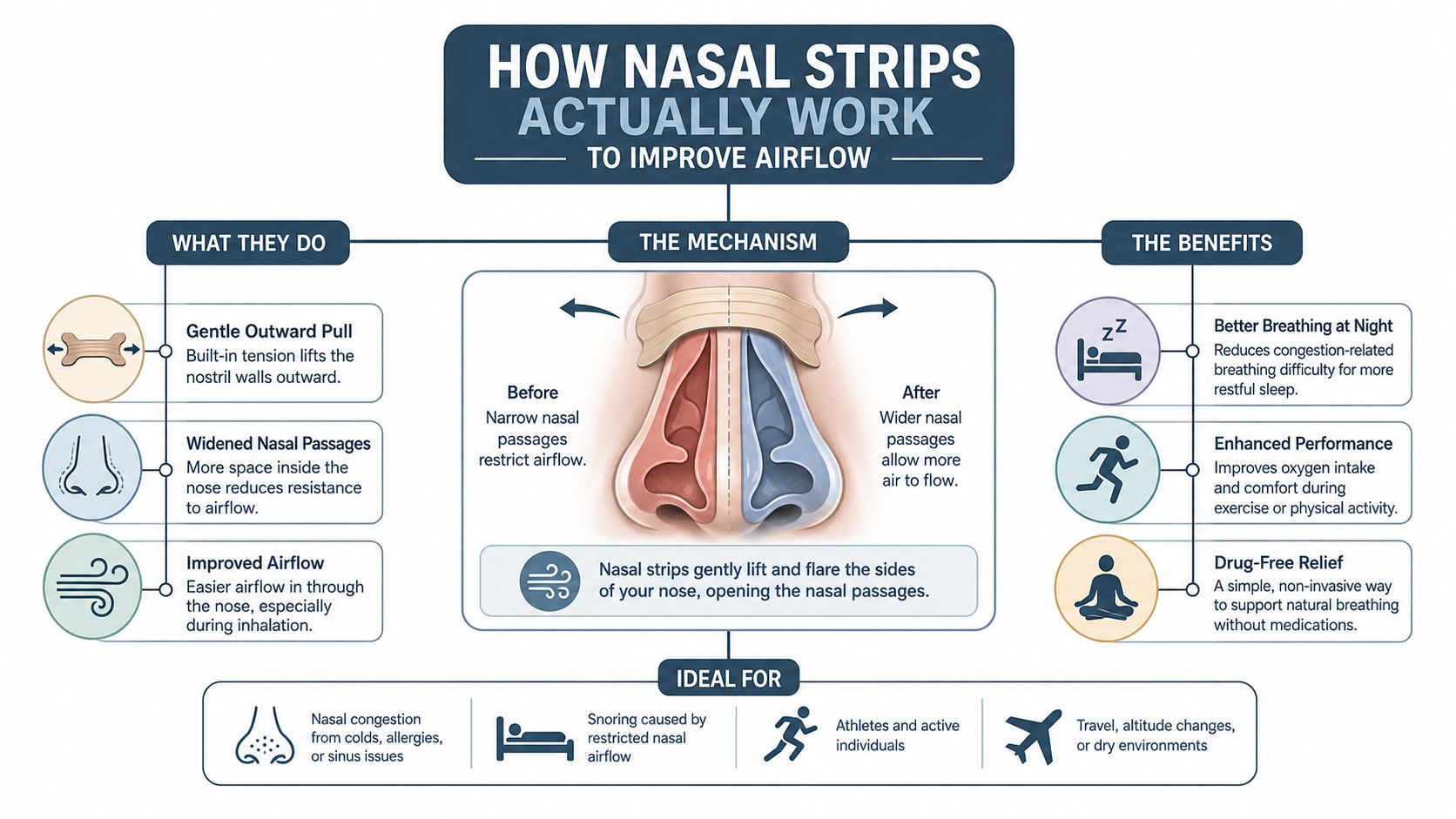
What the airflow measurements show
A randomized patency study involving 50 adults found that all three tested strip designs significantly increased minimum cross-sectional area, nasal volume, and airflow measures from baseline, as reported in the randomized nasal patency study. All three designs reached P < .0001 for minimum cross-sectional area and nasal volume. One butterfly-style strip improved minimum cross-sectional area more than the marketed Breathe Right strip, with P = .0030.
These findings show that strips can change the size and airflow of the nasal passage. They do not show that every user will snore less. Air may pass more easily through the nose while tissues deeper in the airway continue to vibrate or narrow.
Watch the mechanism in action here:
For someone whose main complaint is a stuffy nose at bedtime, Nasal Strips are one external option for supporting smoother nasal airflow. They may improve the feeling of openness, but that change does not prove that snoring, throat narrowing, or sleep apnea has been corrected.
A simple comparison helps clarify the limit. Breathing through a wider straw feels easier than breathing through a narrow one, but it says nothing about whether another part of the route is narrowing. Nasal strips widen one section. Their benefit depends on whether that section caused the breathing effort or snoring sound in the first place.
Comparing External Strips, Internal Dilators, and Aromatic Options
The option that feels strongest is not necessarily the one that addresses the cause of snoring. External strips and internal dilators support the nose, while aromatic products mainly change how breathing feels. That distinction matters because nasal snoring may improve when the nasal passage is narrow, but throat-based snoring and sleep apnea involve problems farther down the airway.
External adhesive strips lift the sides of the nose outward. They work from the surface, so nothing sits inside the nostrils. Internal dilators hold the nostrils open from within, similar to placing a small support inside a flexible tunnel. Both approaches aim to create more room at the nose, but each produces a different sensation during sleep.
Aromatic strips may combine external support with menthol or eucalyptus. The scent can create a cooling impression of clearer breathing. It does not physically remove an obstruction farther down the airway, and a fresh sensation should not be treated as proof that snoring or sleep-disordered breathing has improved.
Nasal snoring product comparison
| Product Type | Mechanism | Best For | Visibility | Skin Irritation Risk |
|---|---|---|---|---|
| External adhesive strip | Pulls the nasal sidewalls outward | People who notice congestion or a narrow-feeling nose | Visible on the nose | Possible itching, redness, irritation, discoloration, or discomfort |
| Internal dilator | Supports the nostrils from inside | People who want expansion without external adhesive | Less visible during sleep | Less related to skin, but may feel uncomfortable inside the nose |
| Aromatic strip | Combines external support with a scent that can make breathing feel clearer | People who value a cooling or refreshing sensation | Usually visible if externally applied | Adhesive and fragrance may bother sensitive skin |
External strips suit someone who wants a simple trial without placing a device inside the nose. Their adhesive can cause itching, redness, irritation, discoloration, or discomfort, however. They also cannot correct snoring caused by relaxed or narrowed tissues in the throat. A strip may improve the first part of the breathing route while leaving the sound-producing area unchanged.
Internal dilators avoid adhesive on the nasal skin, but pressure or awareness inside the nostrils can make sleep less comfortable. The best choice depends on what limits use first: skin sensitivity, dislike of an internal device, or discomfort from fragrance. A product that is removed during the night cannot provide useful support, even if its mechanism fits the problem.
You can explore alternatives to nasal strips if external adhesive does not suit you. Mouth breathing is a separate concern, and Mouth Tape is designed to encourage nasal breathing by keeping the lips comfortably sealed during sleep. It should not conceal blocked nasal breathing or unexplained breathing interruptions. If breathing through your nose is difficult while awake, address that problem before using anything that limits mouth opening at night.
What the Clinical Evidence Actually Shows About Snoring
The evidence becomes less encouraging when researchers measure sleep-disordered breathing instead of nasal openness. A nasal strip can produce a measurable change at the nose, but clinical outcomes ask a different question: does the person stop having breathing interruptions, maintain oxygen levels, or sleep more soundly?
A systematic review and meta-analysis found that nasal dilators didn't significantly improve major obstructive-sleep-apnea outcomes. Across the analyzed trials, the mean difference in apnea-hypopnea index was 0.36 events per hour, with a 95% confidence interval from -2.05 to 2.77 and P = .77, according to the systematic review of nasal dilators for obstructive sleep apnea. The review also found no significant improvement in lowest oxygen saturation or snoring index among people with OSA.
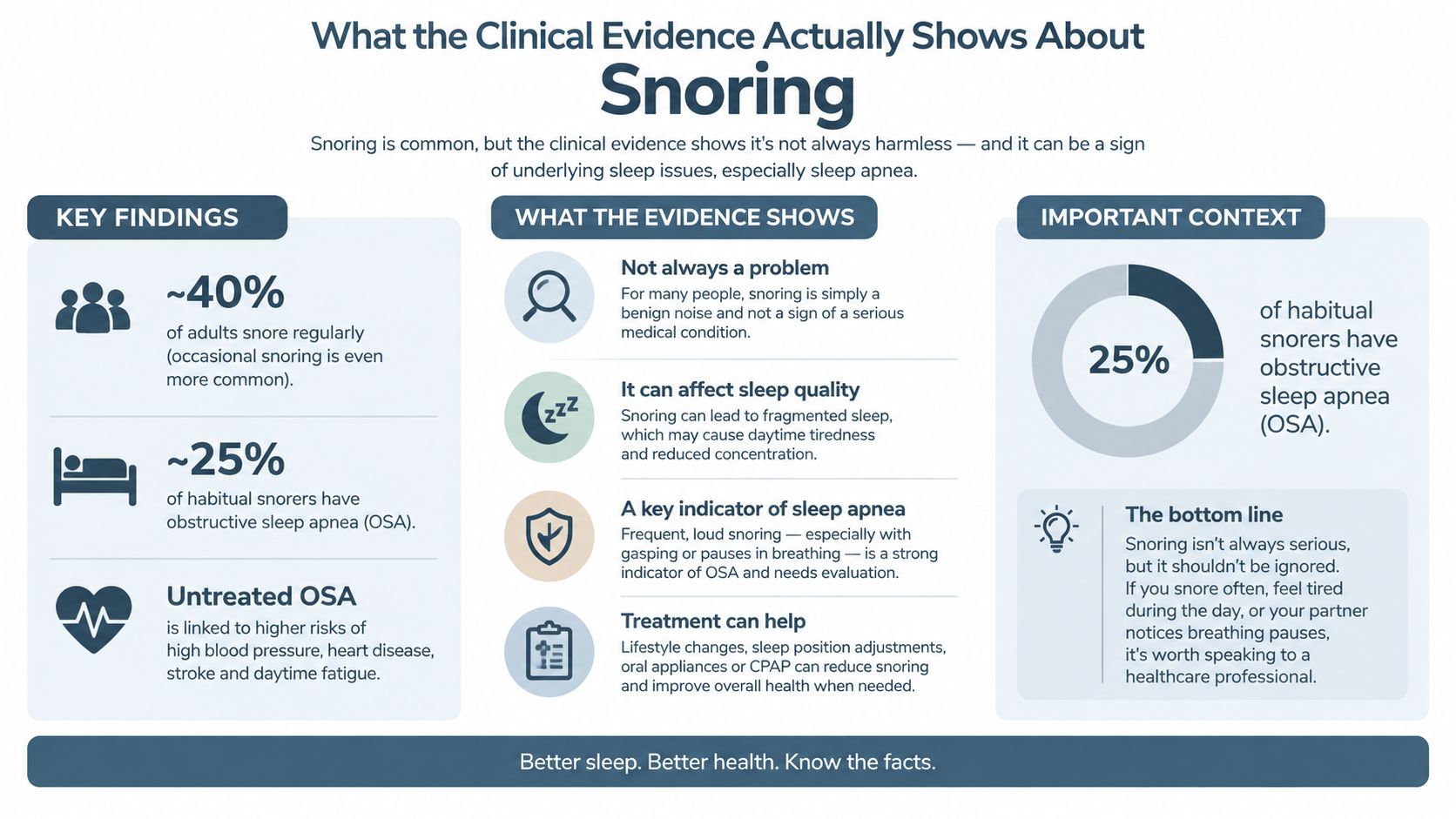
Why subjective improvement can mislead
A person may report that a strip helps because their nose feels less blocked, their mouth stays closed more often, or the sound seems softer to a bed partner. Those are meaningful comfort changes, but they aren't the same as fewer apnea events. Someone can feel better while an obstruction in the throat continues.
Earlier randomized evidence was mixed. A respiratory-medicine review of nine randomized controlled trials found some beneficial effects on subjective snoring and possibly sleep architecture from external dilators, but no reduction in apnea frequency or improvement in daytime sleepiness, as described in the respiratory-medicine review of nasal patency and snoring. The review noted that subjective snoring improvement appeared in only one cited study, while three studies found that Breathe Right treatment didn't improve obstructive sleep-apnea severity or symptoms.
That pattern supports a narrow but useful conclusion. Nasal strips are reasonable as a comfort experiment for nasal-driven snoring, particularly when congestion, rhinitis, or a narrow nasal valve is obvious. They aren't a reliable treatment for diagnosed OSA, and a quieter night shouldn't be used as evidence that oxygen drops or airway obstruction have stopped.
Keep two outcomes separate in your notes:
- Nasal patency: Does air feel easier to draw through your nose?
- Sleep safety: Are breathing pauses, gasping, oxygen changes, or daytime symptoms being addressed?
The first may improve. The second requires a clinical assessment when warning signs are present.
How to Use Nasal Strips Correctly for Best Results
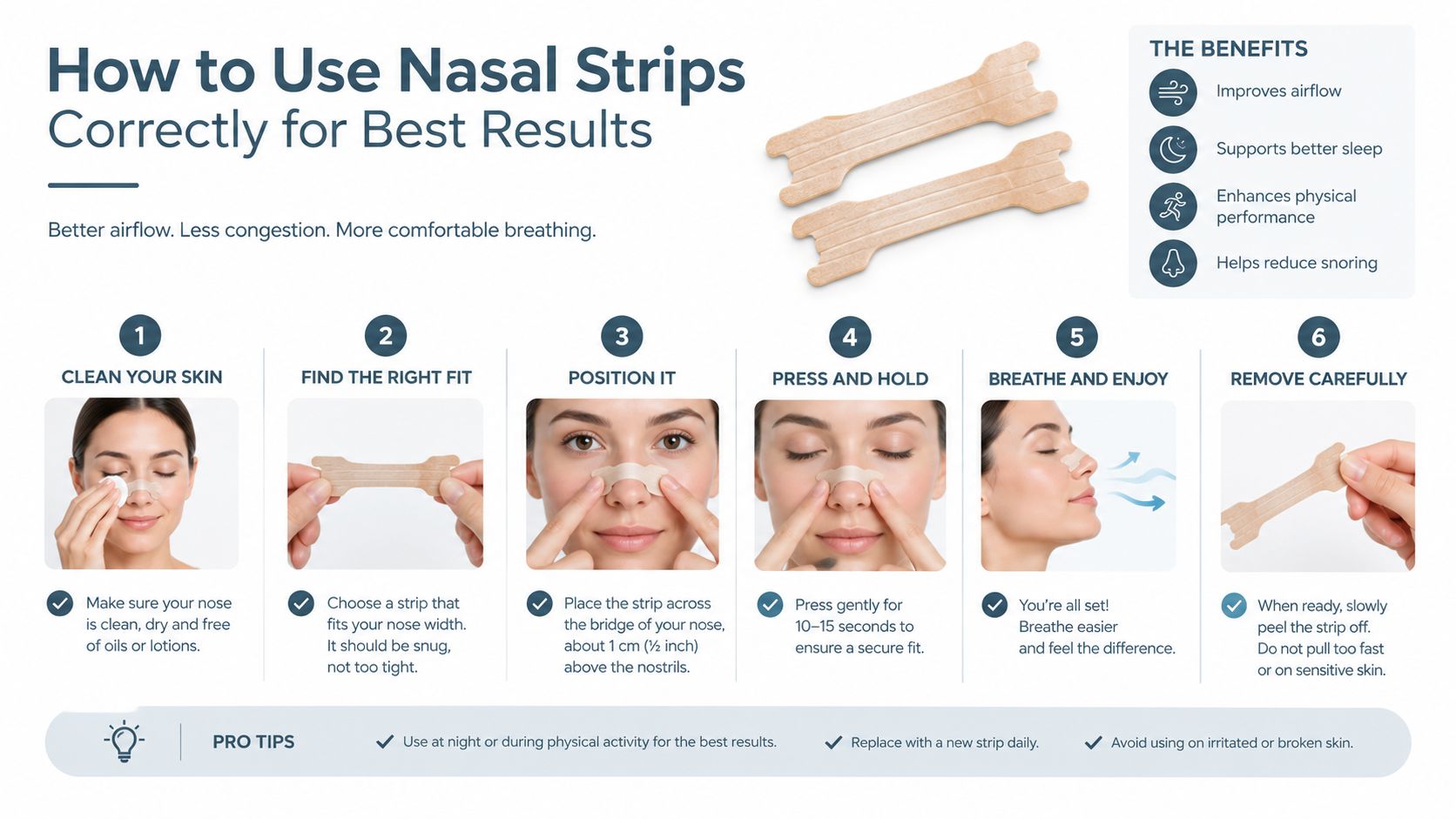
A nasal strip only works as intended when it is placed on clean skin and across the flexible sides of the nose. Oil, moisturizer, and sweat can loosen the adhesive. Placement that is too high, too low, or too close to the nostril openings may provide little support.
A careful application routine
- Clean the skin. Wash and dry your nose thoroughly. Apply the strip only to dry skin, without moisturizer or oily skincare underneath.
- Locate the widest part of the sidewalls. Place the strip across the sides of the nose, where it can gently lift the nasal passages. Keep it off the upper bridge and away from the nostril openings.
- Secure the strip. Anchor the middle first, then smooth both sides outward. Press the adhesive edges firmly for several seconds so they make full contact.
- Remove it slowly. Loosen the strip instead of pulling it sharply. Dampen the adhesive if it resists, then peel it away gradually.
- Stop if your skin reacts. Itching, redness, pain, blistering, discoloration, or ongoing irritation means you should end the trial.
A randomized dermal-tolerability study followed 82 participants using nasal strips for seven consecutive nights. Every participant received a score of 0, indicating no evidence of irritation, at all seven morning assessments, according to the nasal strip tolerability study. The result supports short-term tolerability in that study group. It does not guarantee that every skin type will tolerate the same adhesive.
Measure the result instead of guessing
Try the strip for one week, then compare those nights with nights without it. Keep notes on four practical outcomes:
- Partner-reported snoring: Was the sound quieter or less frequent?
- Awakenings: Did you wake less often, or did your nose feel more open?
- Morning alertness: Do you feel more rested, or is daytime sleepiness unchanged?
- Nasal comfort: Is breathing easier without dryness, pressure, or irritation?
Nasal strips improve airflow at the nostril level, but they do not address collapse in the soft palate or throat. Reduced nasal effort therefore does not guarantee less snoring from obstruction farther down the airway.
A strong pulling sensation is not proof that the strip improved sleep. If snoring continues, guidance from a stop snoring dentist near me may help you consider professional options, particularly when the sound seems throat-based or persists despite comfortable nasal breathing.
For placement and removal details, follow this guide on how to wear nasal strips. Remove the strip if discomfort develops, rather than extending the trial because the product feels easy to use.
When Nasal Strips Are Enough and When to See a Doctor
A nasal strip is a sensible low-risk experiment when snoring appears alongside a blocked nose, a cold, allergies, rhinitis, or known narrowing around the nasal valve. It may make breathing feel easier and could reduce noise when nasal airflow is the main contributor.
Stop treating the strip as the answer if you have loud habitual snoring, witnessed breathing pauses, gasping, choking sounds, or pronounced daytime sleepiness. Those symptoms can point to obstructive sleep apnea, and a nasal strip can't diagnose or treat it.
Controlled research found that external strips increased nasal dimensions and airflow and were generally well tolerated over seven nights. However, a randomized placebo-strip study in people with chronic nighttime congestion didn't significantly improve subjective sleep quality or congestion after about 14 days, and a strong placebo response may have influenced the result, as reported in the controlled research on external nasal strips and nighttime congestion.
If your nose feels open but your snoring, awakenings, or daytime fatigue continue, arrange a medical assessment rather than trying stronger adhesive, more aromatic products, or mouth-sealing methods. A strip can tell you something about nasal comfort. It can't tell you that the deeper airway is functioning safely.
SleepHabits offers nasal strips and complementary nighttime breathing tools for people testing whether nasal airflow affects their snoring, with product choices that include external and aromatic strips. Visit SleepHabits to explore those options and build a cautious routine around measurable changes in nasal comfort, snoring, and morning alertness.