

It's 2 a.m., your partner is snoring, and you've turned the fan up again. Now you're listening to both noises, wondering whether to nudge them, move rooms, or give up on sleep. Figuring out how to block out snoring without earplugs starts with separating two problems: the sound keeping you awake and the breathing that produces it.
Match Your Snoring to the Right Fix
Snoring is a common household problem, but it doesn't have a single cause. A clinical study of elderly patients found a 31.2% point prevalence of reported snoring and cited estimates ranging from 16% to 89% across populations, with reported ranges of 24%–50% in men and 14%–30% in women. Those broad ranges reflect different populations, not your partner's likelihood of having a particular condition.
Start with the pattern you can see for yourself. A snorer who becomes quiet after rolling over needs a different first experiment from someone who sounds congested in every position.
First Fix by Snoring Pattern
| Snoring pattern | First thing to try | Where it is explained |
|---|---|---|
| Louder when the snorer sleeps on their back | Side sleeping with a pillow or wedge | How to Keep the Snorer on Their Side |
| Snoring with a blocked or stuffy nose | Clear the nose before bed, then consider nasal strips | Reduce Snoring at the Source With Nasal and Lifestyle Fixes |
| Steady snoring you can hear through a closed door | Fan or low, steady white noise after checking symptoms | How Sound Masking Hides Snoring Without Harming Sleep |
| Snoring worse after drinks or late meals | Cut alcohol near bedtime and try eating earlier | Reduce Snoring at the Source With Nasal and Lifestyle Fixes |
| Snoring you cannot control tonight and you need sleep | Earlier bedtime or a separate room | Separate Sleeping and Earlier Bedtimes That Protect Sleep |
| Witnessed pauses, gasping, choking or daytime sleepiness | Stop masking as the main plan and run the red-flag check | Confirm the Red Flags Before You Commit to Masking |
Pick the closest match, not every remedy. For a practical trial, use its first fix for seven nights and note position, congestion, evening drinks, and your wake-ups before adding another method. That's an observation schedule, not a deadline for getting better.
The final row isn't another noise-management option. It's a reason to investigate breathing before committing to a sound-only solution.
Confirm the Red Flags Before You Commit to Masking
Masking is a comfort tool, and it can hide a breathing problem. Ordinary snoring doesn't automatically mean obstructive sleep apnea, but the American Academy of Sleep Medicine's oral-appliance guidance notes that snoring is frequently accompanied by OSA and recommends physician-led diagnosis rather than assuming the sound is harmless.
Check what happens around the snoring, not just how loud it sounds.
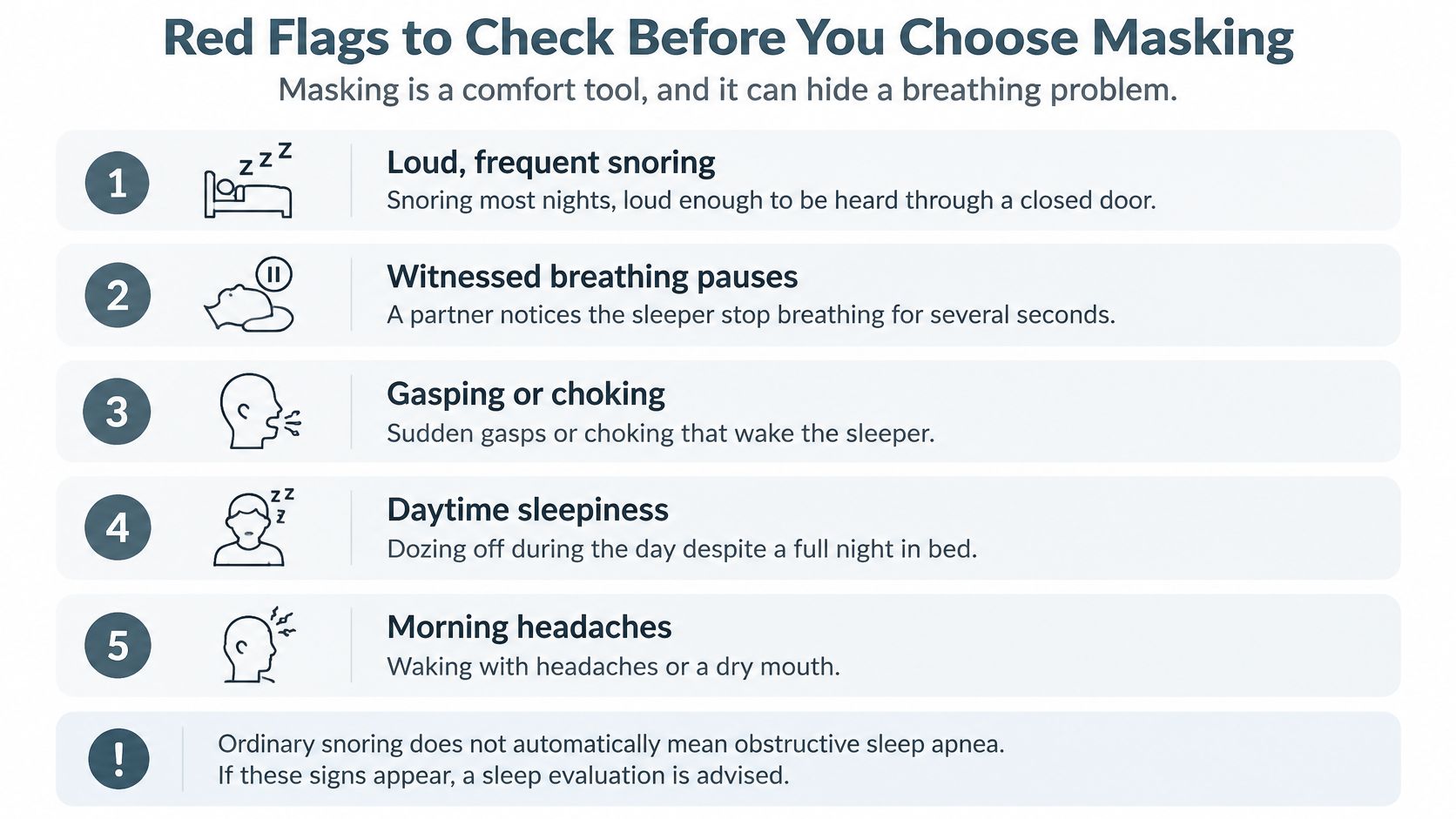
Red-Flag Screen and Required Action
| Screening sign | Action |
|---|---|
| Witnessed breathing pauses | Arrange clinical assessment and ask about sleep testing, even without other symptoms |
| Gasping or choking during sleep | Stop masking as the main plan and arrange medical evaluation |
| Excessive daytime sleepiness | Book clinical assessment and a home or lab sleep test as advised |
| Morning headaches | Record them in the log and review with a clinician |
| Persistent insomnia | Discuss with a clinician and screen for sleep apnea |
The VA/DoD obstructive-sleep-apnea guideline identifies two or more positive STOP screening items as a higher-risk result warranting clinical risk assessment. That refers to the specific STOP screening tool, not any two symptoms chosen from the table, and you shouldn't wait for another symptom if you've witnessed breathing pauses.
A clinician may recommend a technically adequate home sleep-apnea test for a suitable high-suspicion case or laboratory polysomnography. Neither a phone recording nor loudness alone establishes the diagnosis. The explanation of whether snoring is a sign of sleep apnea can help you prepare for that conversation.
If no warning signs are apparent, tonight's comfort plan can be simple: low fan, supported side position, and attention to a blocked nose. Keep a brief log of the snoring and your awakenings.
If a red flag appears, stop treating masking as the main solution and book an assessment for appropriate testing. You can still protect your own sleep while the snorer gets evaluated.
How to Keep the Snorer on Their Side
Back-sleeping can let the tongue fall backward and narrow the throat, making snoring worse. The NHS snoring-options leaflet recommends side sleeping and positional supports when this pattern contributes to the noise.
The useful change isn't just starting on the side. It's making that position comfortable enough to maintain.
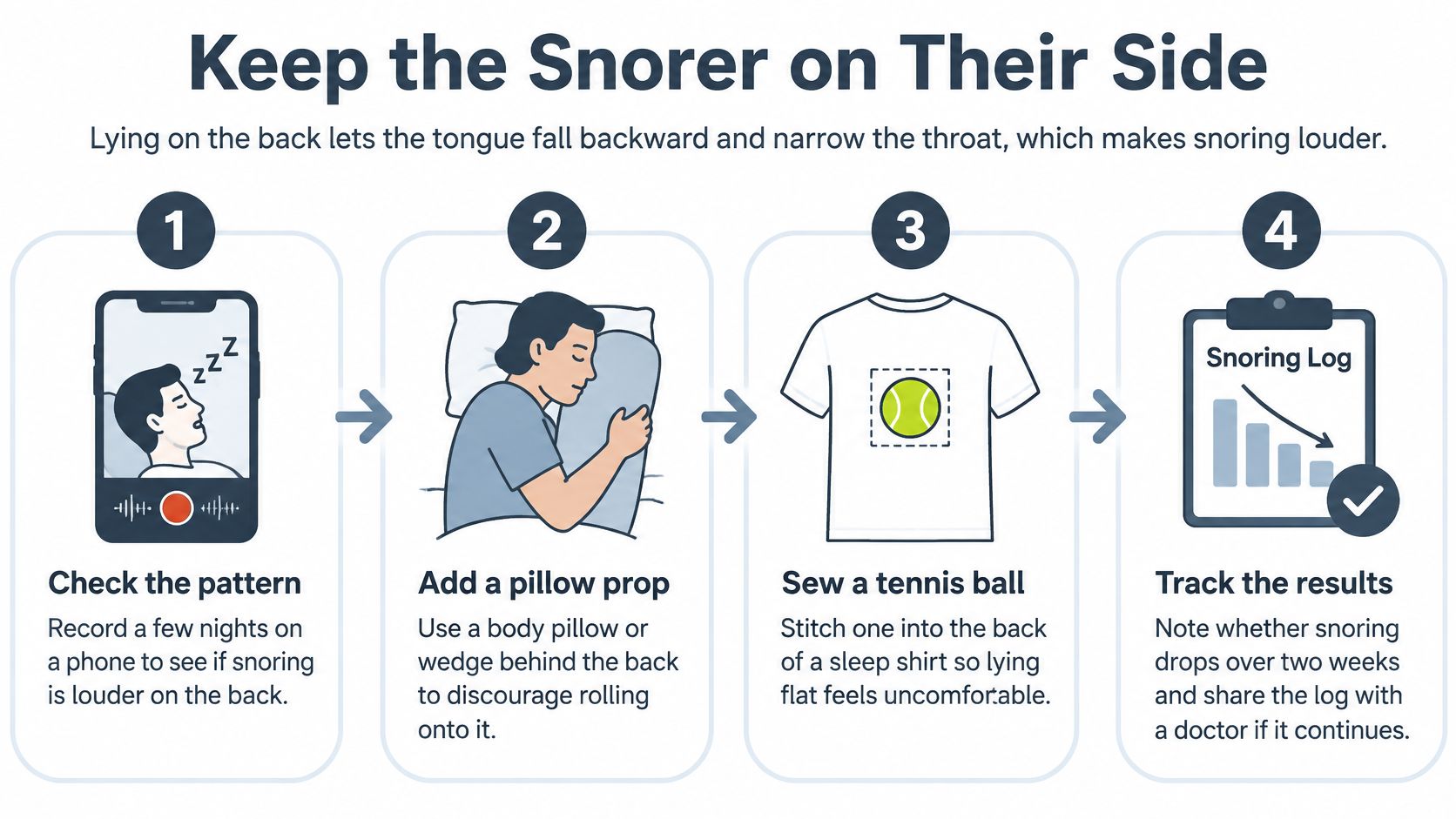
Build a Comfortable Side Position
- Check the pattern first. With your partner's agreement, record the sound and position on a phone, or note whether rolling over changes the snoring. Keep the phone uncovered on a stable surface, not charging beneath bedding. A recording helps identify a pattern; it doesn't diagnose apnea.
- Let the snorer choose the more comfortable side. Forcing an awkward position can replace snoring with repeated waking or shoulder pain.
- Support the torso. Put a body pillow or wedge behind the back to discourage rolling flat. A small cushion that slips away won't offer much support. Keep the neck comfortable rather than stacking pillows until the chin folds toward the chest.
- If comfortable support isn't enough, consider the leaflet's tennis-ball technique: secure a tennis ball to the back of sleepwear so lying flat becomes uncomfortable. Don't use it if it causes pain or makes getting in and out of bed difficult.
- Try the recovery-position variation. Bend the upper leg and place a pillow between the legs. This can make the position feel more stable without relying entirely on pressure against the back.
- Review your observations after an initial trial. If snoring continues while the person remains on their side, position alone isn't enough.
Expect some adjustment, but don't treat discomfort as proof the technique is working. Ease the support if the snorer wakes sore, and stop a setup that interferes with normal movement.
Practical rule: Judge positioning by quieter sleep and comfort, not by how firmly you can prevent someone from rolling over.
A low fan can accompany this approach while you work out whether the positional change really reduces the source.
How Sound Masking Hides Snoring Without Harming Sleep
Sound masking reduces contrast; it doesn't cancel snoring or correct breathing. A steady background makes a sudden snore less prominent against an otherwise quiet bedroom. Complete coverage isn't always achievable at a comfortable volume.
The World Health Organization's noise guidance recommends less than 30 dB(A) inside bedrooms at night for good-quality sleep. Treat that as a quiet-room benchmark, not a masking-device setting or a guarantee that added sound is harmless.
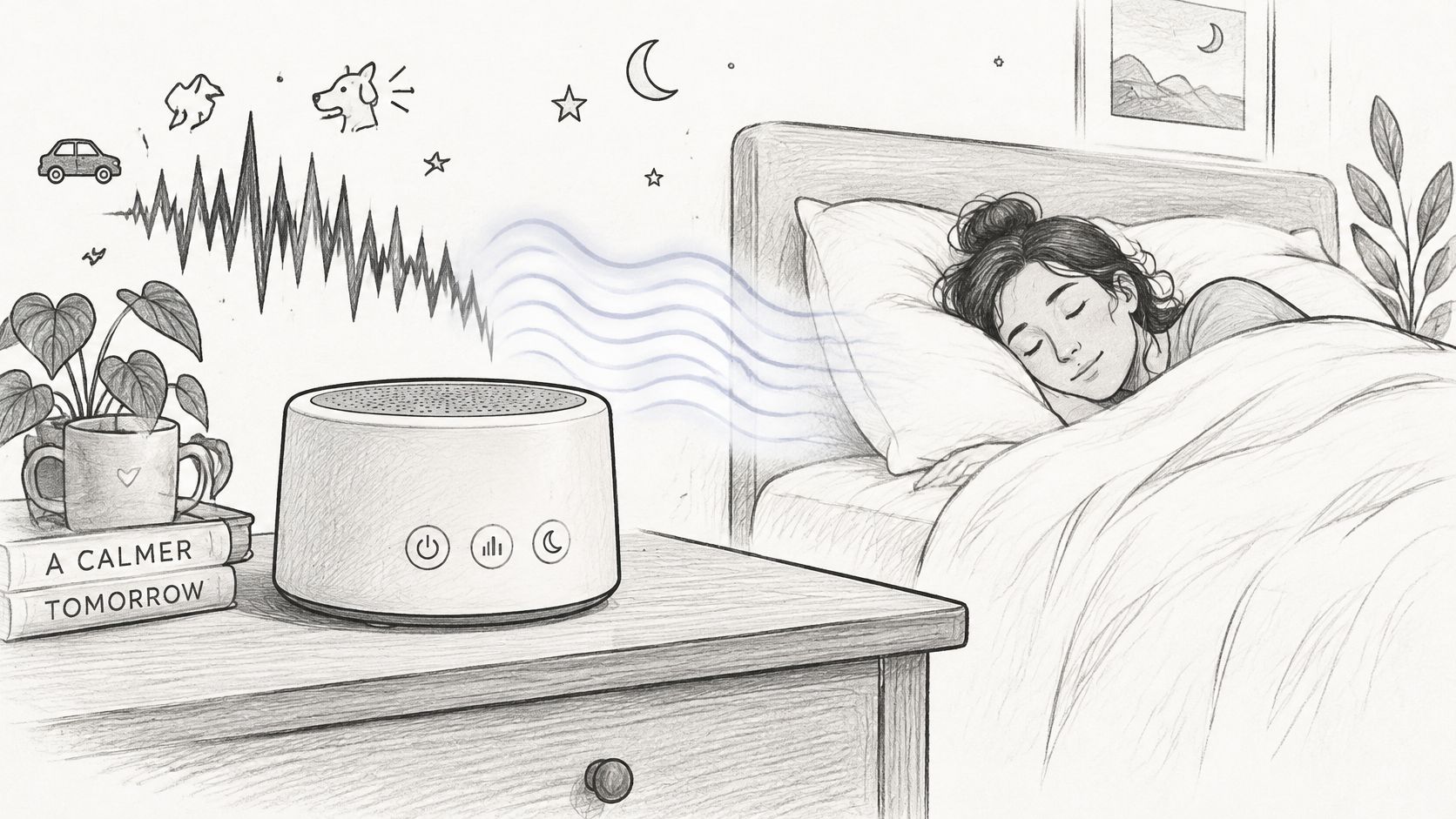
Sound Options for Masking Snoring
| Sound option | Typical level at the pillow | Best for | Watch out for |
|---|---|---|---|
| Box or tower fan on low | Model and distance determine it; check at the pillow | A simple, steady background | Direct airflow on the face; place it across the room |
| White noise machine | Adjustable; start low and keep alarms audible | Consistent masking beside a fixed sleeping position | Audible loops or cycling modes |
| Pink noise track on a speaker | Start low and test while lying down | Listeners who find white noise harsh | An unstable speaker near the bed edge |
| Phone app or streaming sound | No reliable universal level; resist increasing volume repeatedly | Short trials and travel | Ads, notifications, playback stopping |
| Music with changing rhythm | Track-dependent | Relaxing before sleep rather than overnight masking | Changes in rhythm or loudness may wake you |
There's no dependable pillow-level figure based on the device category alone. Distance, room reflections, and the selected setting all matter, so don't assume a fan's low setting means the bedroom remains quiet.
Set It Up Without Adding Another Disturbance
- Start across the room with a fan. Keep airflow off your face and check that the hum isn't accompanied by a rattle.
- Place a sound machine on the listener's side. Use a stable bedside surface, away from bedding, and test it from your actual sleeping position.
- Choose continuity. Disable notifications and avoid tracks with voices, thunderclaps, obvious loop seams, or abrupt endings.
- Check the alarm. Test it with the sound playing and your head on the pillow. A comfortable volume shouldn't prevent you from hearing important alerts.
- Match timing to the problem. A timer may suit trouble falling asleep, but it won't help later awakenings once playback stops.
Changing-rhythm music can introduce its own surprises. If music helps you unwind, use natural sleep music before bed, then compare it with a neutral continuous sound for overnight use.
I would start with a steady fan on low and assess whether you wake less often. If adequate masking requires an uncomfortable volume, change the strategy rather than keep turning it up.
Bed and Room Changes That Cut Snoring Noise
A bare, echoing bedroom can make snoring sound harsher. Use distance first, then soften reflections with heavy curtains, a rug over hard flooring, or a draught excluder beneath a closed door. These changes may make the room less echo-prone, but they cannot soundproof it or address breathing problems.
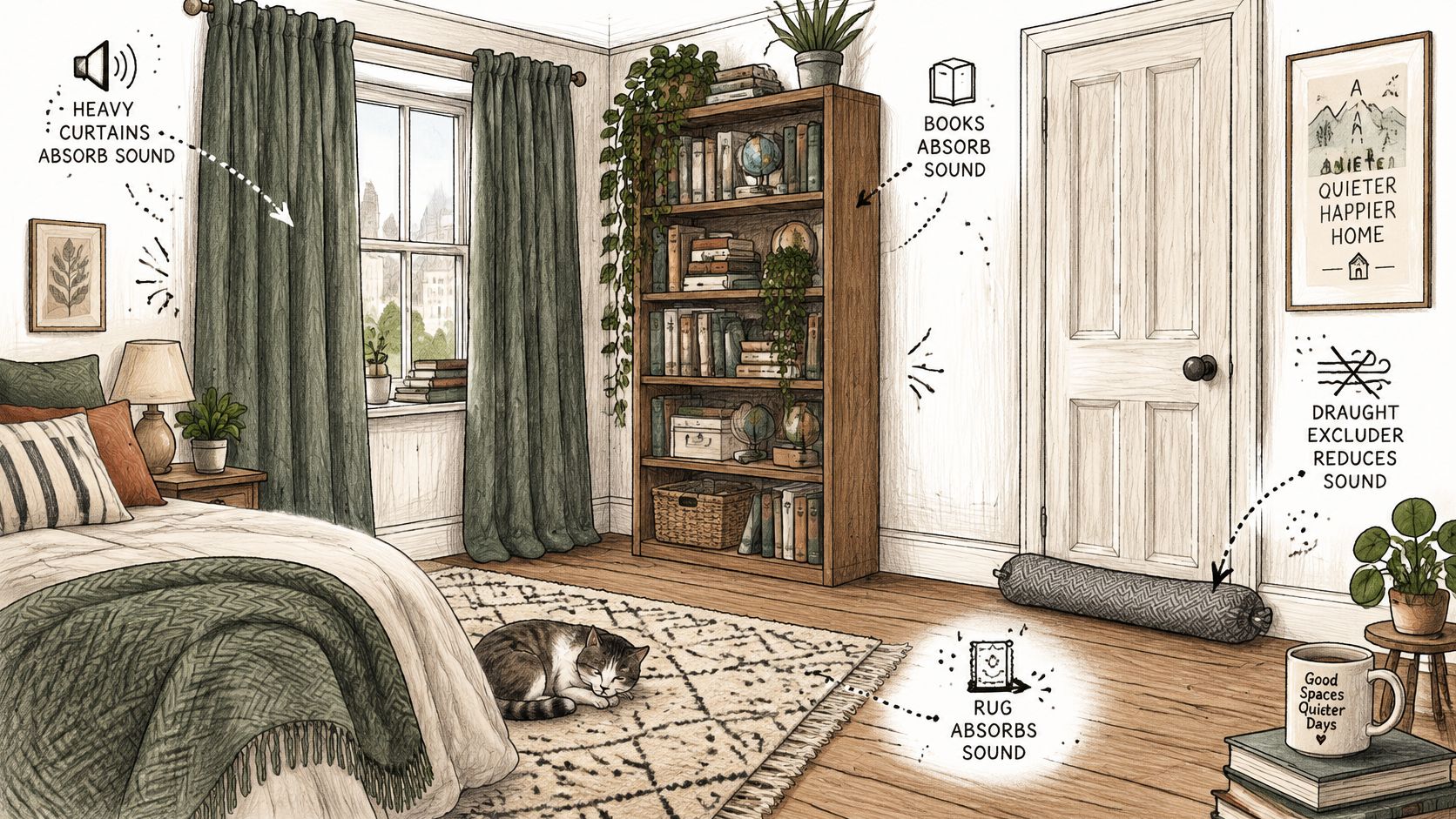
Change the Sound Path Before Buying Equipment
Move the bed away from a bare shared wall if the room allows. Increase the distance between the snorer's head and your pillow, while keeping both of you in comfortable sleeping positions. A bookshelf or wardrobe along a shared wall may help alter the sound path. Secure tall furniture and keep ventilation clear. A door seal is most useful when you sleep elsewhere and sound travels through the hallway.
If you're considering changes to upper-body support, Miller Waldrop's mattress advice for snoring offers a furniture-focused starting point. A mattress change may affect comfort and positioning, but it should not be treated as a fix for an airway problem.
Understand the Limits of Active Noise Control
An experimental headboard-and-pillow acoustic study reported average listener-ear reductions of approximately 13 dB with a headboard configuration and 17 dB with a pillow configuration, targeting predominantly low-frequency snoring components below 2 kHz. These figures describe an experimental acoustic system, not a clinical success rate or a promise for consumer speakers.
The setup uses a sensing microphone near the snorer's head to identify the strongest sound direction, then places a cancellation speaker between the source and listener. Check performance at the listener's ear, since microphone readings alone do not show what reaches the pillow. Head movement, changes in snore direction, and mattress reflections can weaken cancellation.
The embedded video shows the cancellation setup; skip it unless you're considering a commercial system.
In a home bedroom, active cancellation is a specialized option that requires careful positioning and checking. Ordinary speakers under pillows are not a substitute. Keep powered devices clear of breathing space and bedding, and prevent loose cables from reaching the bed.
Reduce Snoring at the Source With Nasal and Lifestyle Fixes
A stuffy nose can encourage mouth breathing and contribute to snoring. The NHS guidance on snoring identifies nasal blockage as a contributor and lists nasal strips or dilators as options when narrowed nasal airways are involved.
Start with a simple routine before trying several products at once. A saline spray can ease nasal discomfort. For a rinse, use sterile or distilled water, or water that has been boiled and cooled, and clean the device as directed. A pharmacist or clinician can help match allergy treatment or nasal medicine to the cause.
Source Fixes, Targets and Skip Conditions
| Fix | What it targets | Use it when | Skip it when |
|---|---|---|---|
| Saline rinse or spray before bed | Nasal congestion and dryness | The nose feels stuffy at night | The preparation irritates; saline does not treat the same problem as medicated decongestants |
| Nasal Strips, including adhesive or aromatic versions | Narrow nasal passages | The nose feels blocked when lying down | Skin irritation occurs or the obstruction is in the throat |
| Mouth tape | Keeps lips together, without treating an obstruction | Only after discussing suitability with a clinician | The nose is blocked, there is a cold, suspected apnea, or breathing pauses |
| Evening alcohol cut | Alcohol-related throat relaxation | Snoring worsens after drinks | Snoring persists on sober nights |
| Weight management | Weight-related airway narrowing | Snoring developed alongside weight gain | Immediate relief is needed or medical assessment is being delayed |
Mouth-open snoring alone does not make mouth tape a suitable fix. A nose that feels clear while awake does not confirm that breathing will stay unobstructed during sleep. Avoid using mouth tape as a first-line snoring experiment, especially if breathing symptoms are present.
Match the Remedy to the Obstruction
Nasal strips work at the nose, not the throat. The guide to nasal strips for snoring explains this distinction. External strips are intended to help hold the nasal passages open; an aromatic feature does not establish greater effectiveness.
Saline sprays and medicated decongestant sprays have different uses. Follow the medicine's stated duration, and ask a pharmacist or clinician before using it longer. Persistent blockage calls for assessment rather than repeated self-treatment.
For evening habits, remove alcohol near bedtime if it clearly corresponds with louder nights. If late meals also seem associated with snoring, try eating earlier as a personal experiment, without assuming it will solve the problem. Weight management, when relevant, takes time and is not an immediate fix.
Change one source-focused measure at a time so you can judge whether it helps. Keep your basic sleep-protection arrangements stable while testing it.
For ongoing symptoms, Dental Professionals of Fair Lawn explains options to find help for persistent snoring. Get medical assessment before assuming a dental device is appropriate, particularly when breathing symptoms are present.
Separate Sleeping and Earlier Bedtimes That Protect Sleep
You don't have to keep proving you can tolerate the noise. In a 2024 finding reported by the Sleep Foundation, 75% of U.S. adults who shared a bed with a snorer said the snoring affected their sleep.
A 2024 AASM-commissioned survey of 2,006 U.S. adults also examined separate sleeping arrangements, reflecting that couples use sleeping apart as a practical accommodation. It isn't automatically a verdict on the relationship.
Try Timing Before Relocation
NHS Lothian's sleep-disordered-breathing guidance includes going to bed before the snoring partner and, when necessary, using another room. Getting to sleep first may help with sleep onset, although it won't guarantee protection from later snoring.
For example, agree on a two-week household trial:
- Prepare the alternative room. Use a comfortable bed and a low fan if you find it helpful.
- Try moving the non-snorer's bedtime 30 minutes earlier, with the snorer joining later.
- Use the separate room when needed. Decide beforehand who moves so you're not negotiating while exhausted.
- Record nights with awakenings and how each person feels in the morning.
- Review together. Keep the arrangement that protects sleep while continuing to address the snoring.
These timings are trial choices, not prescribed treatment durations. Preserve shared time before bed so sleeping arrangements don't become your only daily conversation.
If pauses, choking, or marked daytime fatigue persist, use the red-flag assessment pathway rather than just extending the separate-room arrangement. Distance can protect your sleep; it doesn't establish that your partner's breathing is safe.
SleepHabits offers educational sleep guides and nasal-breathing tools to help you build a more comfortable nighttime routine. Visit SleepHabits to compare practical options for nasal airflow and sleep habits, then choose one appropriate change to try while arranging medical assessment for any breathing warning signs.